Skip to content

Stabilarity Hub

Menu
  • Home
  • Research
    • Healthcare & Life Sciences
      • Medical ML Diagnosis
    • Enterprise & Economics
      • AI Economics
      • Cost-Effective AI
      • Spec-Driven AI
    • Geopolitics & Strategy
      • Anticipatory Intelligence
      • Future of AI
      • Geopolitical Risk Intelligence
    • AI & Future Signals
      • Capability–Adoption Gap
      • AI Observability
      • AI Intelligence Architecture
      • AI Memory
      • Trusted Open Source
    • Data Science & Methods
      • HPF-P Framework
      • Intellectual Data Analysis
      • Reference Evaluation
    • Publications
      • External Publications
    • Robotics & Engineering
      • Open Humanoid
    • Benchmarks & Measurement
      • Universal Intelligence Benchmark
      • Shadow Economy Dynamics
      • Article Quality Science
  • Tools
    • Healthcare & Life Sciences
      • ScanLab
      • AI Data Readiness Assessment
    • Enterprise Strategy
      • AI Use Case Classifier
      • ROI Calculator
      • Risk Calculator
      • Reference Trust Analyzer
    • Portfolio & Analytics
      • HPF Portfolio Optimizer
      • Adoption Gap Monitor
      • Data Mining Method Selector
    • Geopolitics & Prediction
      • War Prediction Model
      • Ukraine Crisis Prediction
      • Gap Analyzer
      • Geopolitical Stability Dashboard
    • Technical & Observability
      • OTel AI Inspector
    • Robotics & Engineering
      • Humanoid Simulation
    • Benchmarks
      • UIB Benchmark Tool
  • API Gateway
  • About
    • Contributors
  • Contact
  • Join Community
  • Terms of Service
  • Login
  • Register
Menu

ML Model Taxonomy for Medical Imaging

Posted on February 8, 2026March 5, 2026 by
Medical Research
Medical Research by Oleh Ivchenko  ·  DOI: 10.5281/zenodo.18752900  48stabilfr·wdophcgmx
BadgeMetricValueStatusDescription
[s]Reviewed Sources0%○≥80% from editorially reviewed sources
[t]Trusted100%✓≥80% from verified, high-quality sources
[a]DOI17%○≥80% have a Digital Object Identifier
[b]CrossRef0%○≥80% indexed in CrossRef
[i]Indexed50%○≥80% have metadata indexed
[l]Academic50%○≥80% from journals/conferences/preprints
[f]Free Access100%✓≥80% are freely accessible
[r]References6 refs○Minimum 10 references required
[w]Words [REQ]1,047✗Minimum 2,000 words for a full research article. Current: 1,047
[d]DOI [REQ]✓✓Zenodo DOI registered for persistent citation. DOI: 10.5281/zenodo.18752900
[o]ORCID [REQ]✓✓Author ORCID verified for academic identity
[p]Peer Reviewed [REQ]—✗Peer reviewed by an assigned reviewer
[h]Freshness [REQ]0%✗≥80% of references from 2025–2026. Current: 0%
[c]Data Charts0○Original data charts from reproducible analysis (min 2). Current: 0
[g]Code—○Source code available on GitHub
[m]Diagrams3✓Mermaid architecture/flow diagrams. Current: 3
[x]Cited by0○Referenced by 0 other hub article(s)
Score = Ref Trust (55 × 60%) + Required (2/5 × 30%) + Optional (1/4 × 10%)
Article #4 in "Machine Learning for Medical Diagnosis" Research Series By Oleh Ivchenko, Researcher, ONPU | Stabilarity Hub | February 8, 2026 Questions Addressed: How do CNN, ViT, and hybrid models compare for medical imaging? Which architecture is best for specific modalities?

Show moreHide
Medical Research by Oleh Ivchenko DOI: 10.5281/zenodo.18752900 48stabilfr·wdophcgmx
BadgeMetricValueStatusDescription
[s]Reviewed Sources0%○≥80% from editorially reviewed sources
[t]Trusted100%✓≥80% from verified, high-quality sources
[a]DOI17%○≥80% have a Digital Object Identifier
[b]CrossRef0%○≥80% indexed in CrossRef
[i]Indexed50%○≥80% have metadata indexed
[l]Academic50%○≥80% from journals/conferences/preprints
[f]Free Access100%✓≥80% are freely accessible
[r]References6 refs○Minimum 10 references required
[w]Words [REQ]1,047✗Minimum 2,000 words for a full research article. Current: 1,047
[d]DOI [REQ]✓✓Zenodo DOI registered for persistent citation. DOI: 10.5281/zenodo.18752900
[o]ORCID [REQ]✓✓Author ORCID verified for academic identity
[p]Peer Reviewed [REQ]—✗Peer reviewed by an assigned reviewer
[h]Freshness [REQ]0%✗≥80% of references from 2025–2026. Current: 0%
[c]Data Charts0○Original data charts from reproducible analysis (min 2). Current: 0
[g]Code—○Source code available on GitHub
[m]Diagrams3✓Mermaid architecture/flow diagrams. Current: 3
[x]Cited by0○Referenced by 0 other hub article(s)
Score = Ref Trust (55 × 60%) + Required (2/5 × 30%) + Optional (1/4 × 10%)
Medical ML DiagnosisRead More
Read more

Ukrainian Healthcare System: Current Medical Imaging Practices

Posted on February 8, 2026March 9, 2026 by
Medical Research
Medical Research by Oleh Ivchenko  ·  DOI: 10.5281/zenodo.18752902  

Ukraine's healthcare system represents a unique case study in digital transformation under extraordinary circumstances. The two-level electronic healthcare system (EHS), with 36 million registered patients and 1.6 billion electronic medical records, provides a robust foundation for AI integration—despite wartime challenges that reduced viable Medical Information System (MIS) providers from 40 t...

Show moreHide
Medical Research by Oleh Ivchenko DOI: 10.5281/zenodo.18752902
Medical ML DiagnosisRead More
Read more

State of Medical AI Adoption: 1,200 Devices Approved, 81% of Hospitals at Zero

Posted on February 8, 2026March 4, 2026 by Admin
DOI: 10.5281/zenodo.18752906  72stabilfr·wdophcgmx
BadgeMetricValueStatusDescription
[s]Reviewed Sources0%○≥80% from editorially reviewed sources
[t]Trusted100%✓≥80% from verified, high-quality sources
[a]DOI100%✓≥80% have a Digital Object Identifier
[b]CrossRef0%○≥80% indexed in CrossRef
[i]Indexed100%✓≥80% have metadata indexed
[l]Academic0%○≥80% from journals/conferences/preprints
[f]Free Access100%✓≥80% are freely accessible
[r]References1 refs○Minimum 10 references required
[w]Words [REQ]2,704✓Minimum 2,000 words for a full research article. Current: 2,704
[d]DOI [REQ]✓✓Zenodo DOI registered for persistent citation. DOI: 10.5281/zenodo.18752906
[o]ORCID [REQ]✓✓Author ORCID verified for academic identity
[p]Peer Reviewed [REQ]—✗Peer reviewed by an assigned reviewer
[h]Freshness [REQ]100%✓≥80% of references from 2025–2026. Current: 100%
[c]Data Charts0○Original data charts from reproducible analysis (min 2). Current: 0
[g]Code—○Source code available on GitHub
[m]Diagrams3✓Mermaid architecture/flow diagrams. Current: 3
[x]Cited by0○Referenced by 0 other hub article(s)
Score = Ref Trust (76 × 60%) + Required (4/5 × 30%) + Optional (1/4 × 10%)

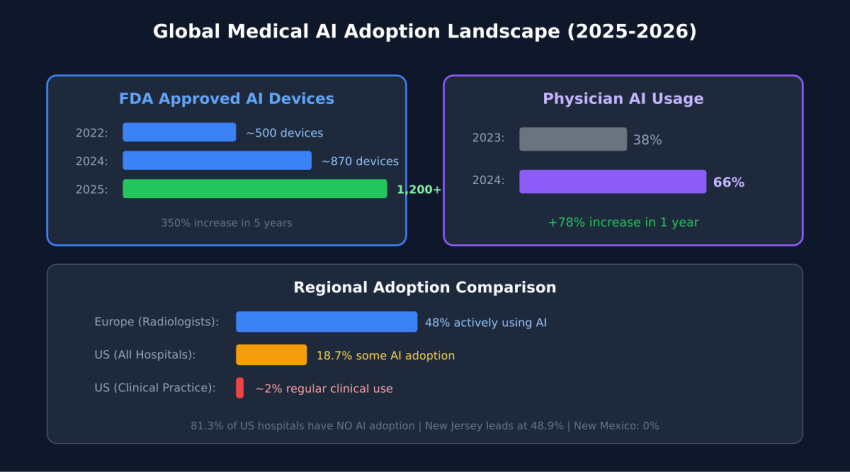
Global medical AI has exploded with 1,200+ FDA-approved devices, yet 81% of US hospitals have no AI adoption. Article #2 maps the adoption paradox, regional variation, success rates by use case, and the critical barriers—with lessons for Ukrainian healthcare.

Show moreHide
DOI: 10.5281/zenodo.18752906 72stabilfr·wdophcgmx
BadgeMetricValueStatusDescription
[s]Reviewed Sources0%○≥80% from editorially reviewed sources
[t]Trusted100%✓≥80% from verified, high-quality sources
[a]DOI100%✓≥80% have a Digital Object Identifier
[b]CrossRef0%○≥80% indexed in CrossRef
[i]Indexed100%✓≥80% have metadata indexed
[l]Academic0%○≥80% from journals/conferences/preprints
[f]Free Access100%✓≥80% are freely accessible
[r]References1 refs○Minimum 10 references required
[w]Words [REQ]2,704✓Minimum 2,000 words for a full research article. Current: 2,704
[d]DOI [REQ]✓✓Zenodo DOI registered for persistent citation. DOI: 10.5281/zenodo.18752906
[o]ORCID [REQ]✓✓Author ORCID verified for academic identity
[p]Peer Reviewed [REQ]—✗Peer reviewed by an assigned reviewer
[h]Freshness [REQ]100%✓≥80% of references from 2025–2026. Current: 100%
[c]Data Charts0○Original data charts from reproducible analysis (min 2). Current: 0
[g]Code—○Source code available on GitHub
[m]Diagrams3✓Mermaid architecture/flow diagrams. Current: 3
[x]Cited by0○Referenced by 0 other hub article(s)
Score = Ref Trust (76 × 60%) + Required (4/5 × 30%) + Optional (1/4 × 10%)
Read More
Read more
6-phase research framework for ML-augmented medical diagnosis

ML for Medical Diagnosis: Research Goals and Framework for Ukrainian Healthcare

Posted on February 8, 2026February 24, 2026 by Admin
Medical Research
Medical Research by Oleh Ivchenko  ·  DOI: 10.5281/zenodo.18752908  49stabilfr·wdophcgmx
BadgeMetricValueStatusDescription
[s]Reviewed Sources44%○≥80% from editorially reviewed sources
[t]Trusted67%○≥80% from verified, high-quality sources
[a]DOI44%○≥80% have a Digital Object Identifier
[b]CrossRef22%○≥80% indexed in CrossRef
[i]Indexed44%○≥80% have metadata indexed
[l]Academic56%○≥80% from journals/conferences/preprints
[f]Free Access22%○≥80% are freely accessible
[r]References9 refs○Minimum 10 references required
[w]Words [REQ]876✗Minimum 2,000 words for a full research article. Current: 876
[d]DOI [REQ]✓✓Zenodo DOI registered for persistent citation. DOI: 10.5281/zenodo.18752908
[o]ORCID [REQ]✓✓Author ORCID verified for academic identity
[p]Peer Reviewed [REQ]—✗Peer reviewed by an assigned reviewer
[h]Freshness [REQ]0%✗≥80% of references from 2025–2026. Current: 0%
[c]Data Charts0○Original data charts from reproducible analysis (min 2). Current: 0
[g]Code—○Source code available on GitHub
[m]Diagrams3✓Mermaid architecture/flow diagrams. Current: 3
[x]Cited by0○Referenced by 0 other hub article(s)
Score = Ref Trust (57 × 60%) + Required (2/5 × 30%) + Optional (1/4 × 10%)
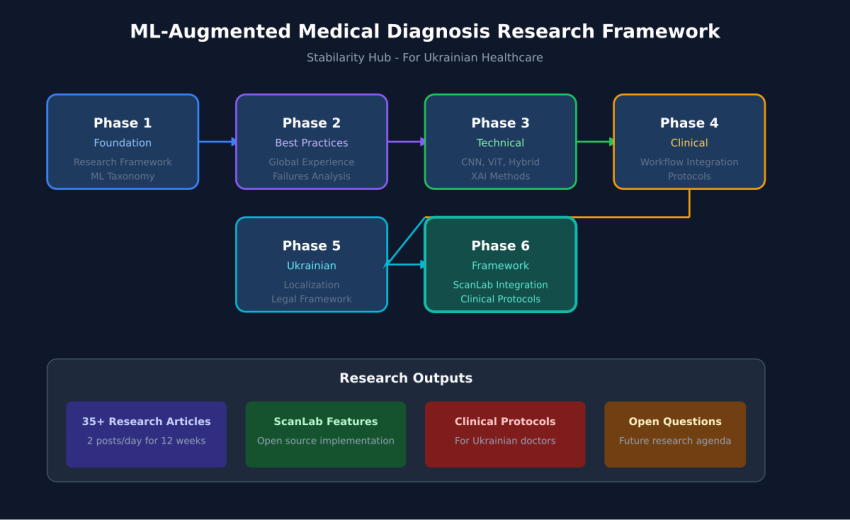
Launching a 12-week research program to build a practical framework for ML-augmented medical image diagnosis in Ukrainian healthcare. Article #1 establishes methodology, introduces Stabilarity Hub ecosystem, and outlines the path from research to ScanLab implementation.

Show moreHide
Medical Research by Oleh Ivchenko DOI: 10.5281/zenodo.18752908 49stabilfr·wdophcgmx
BadgeMetricValueStatusDescription
[s]Reviewed Sources44%○≥80% from editorially reviewed sources
[t]Trusted67%○≥80% from verified, high-quality sources
[a]DOI44%○≥80% have a Digital Object Identifier
[b]CrossRef22%○≥80% indexed in CrossRef
[i]Indexed44%○≥80% have metadata indexed
[l]Academic56%○≥80% from journals/conferences/preprints
[f]Free Access22%○≥80% are freely accessible
[r]References9 refs○Minimum 10 references required
[w]Words [REQ]876✗Minimum 2,000 words for a full research article. Current: 876
[d]DOI [REQ]✓✓Zenodo DOI registered for persistent citation. DOI: 10.5281/zenodo.18752908
[o]ORCID [REQ]✓✓Author ORCID verified for academic identity
[p]Peer Reviewed [REQ]—✗Peer reviewed by an assigned reviewer
[h]Freshness [REQ]0%✗≥80% of references from 2025–2026. Current: 0%
[c]Data Charts0○Original data charts from reproducible analysis (min 2). Current: 0
[g]Code—○Source code available on GitHub
[m]Diagrams3✓Mermaid architecture/flow diagrams. Current: 3
[x]Cited by0○Referenced by 0 other hub article(s)
Score = Ref Trust (57 × 60%) + Required (2/5 × 30%) + Optional (1/4 × 10%)
Medical ML DiagnosisRead More
Read more
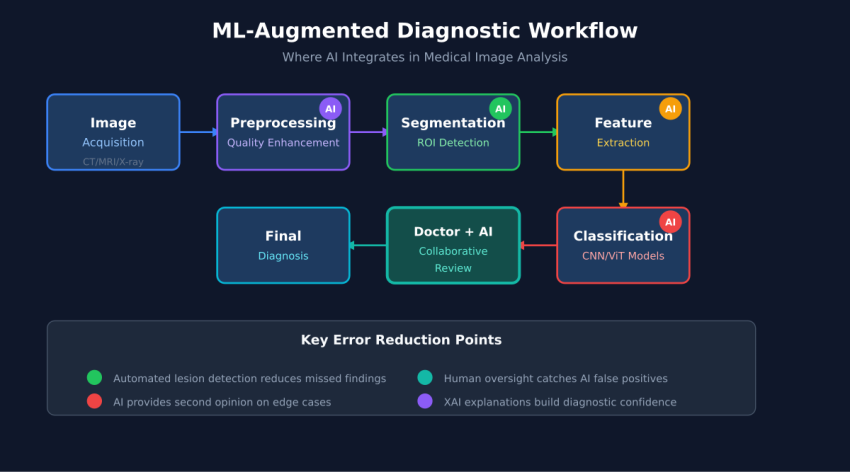
Diagram showing how ML integrates into medical image analysis workflow from acquisition to diagnosis

Image Classification and ML in Disease Recognition: A Research Review

Posted on February 8, 2026February 25, 2026 by Admin
Medical Research
Medical Research by Oleh Ivchenko  ·  DOI: 10.5281/zenodo.18752910  62stabilfr·wdophcgmx
BadgeMetricValueStatusDescription
[s]Reviewed Sources60%○≥80% from editorially reviewed sources
[t]Trusted100%✓≥80% from verified, high-quality sources
[a]DOI80%✓≥80% have a Digital Object Identifier
[b]CrossRef40%○≥80% indexed in CrossRef
[i]Indexed60%○≥80% have metadata indexed
[l]Academic60%○≥80% from journals/conferences/preprints
[f]Free Access40%○≥80% are freely accessible
[r]References5 refs○Minimum 10 references required
[w]Words [REQ]1,976✗Minimum 2,000 words for a full research article. Current: 1,976
[d]DOI [REQ]✓✓Zenodo DOI registered for persistent citation. DOI: 10.5281/zenodo.18752910
[o]ORCID [REQ]✓✓Author ORCID verified for academic identity
[p]Peer Reviewed [REQ]—✗Peer reviewed by an assigned reviewer
[h]Freshness [REQ]0%✗≥80% of references from 2025–2026. Current: 0%
[c]Data Charts0○Original data charts from reproducible analysis (min 2). Current: 0
[g]Code—○Source code available on GitHub
[m]Diagrams5✓Mermaid architecture/flow diagrams. Current: 5
[x]Cited by0○Referenced by 0 other hub article(s)
Score = Ref Trust (79 × 60%) + Required (2/5 × 30%) + Optional (1/4 × 10%)

A comprehensive review of machine learning in medical image analysis, examining which ML techniques apply at each diagnostic stage, evidence-based best practices for doctor-AI collaboration, and unique conclusions on reducing diagnostic errors.

Show moreHide
Medical Research by Oleh Ivchenko DOI: 10.5281/zenodo.18752910 62stabilfr·wdophcgmx
BadgeMetricValueStatusDescription
[s]Reviewed Sources60%○≥80% from editorially reviewed sources
[t]Trusted100%✓≥80% from verified, high-quality sources
[a]DOI80%✓≥80% have a Digital Object Identifier
[b]CrossRef40%○≥80% indexed in CrossRef
[i]Indexed60%○≥80% have metadata indexed
[l]Academic60%○≥80% from journals/conferences/preprints
[f]Free Access40%○≥80% are freely accessible
[r]References5 refs○Minimum 10 references required
[w]Words [REQ]1,976✗Minimum 2,000 words for a full research article. Current: 1,976
[d]DOI [REQ]✓✓Zenodo DOI registered for persistent citation. DOI: 10.5281/zenodo.18752910
[o]ORCID [REQ]✓✓Author ORCID verified for academic identity
[p]Peer Reviewed [REQ]—✗Peer reviewed by an assigned reviewer
[h]Freshness [REQ]0%✗≥80% of references from 2025–2026. Current: 0%
[c]Data Charts0○Original data charts from reproducible analysis (min 2). Current: 0
[g]Code—○Source code available on GitHub
[m]Diagrams5✓Mermaid architecture/flow diagrams. Current: 5
[x]Cited by0○Referenced by 0 other hub article(s)
Score = Ref Trust (79 × 60%) + Required (2/5 × 30%) + Optional (1/4 × 10%)
Medical ML DiagnosisRead More
Read more
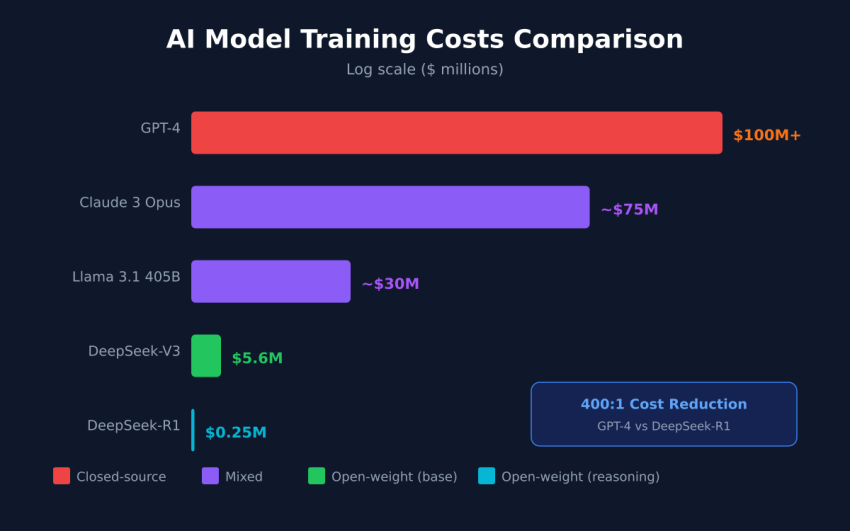
Chart comparing AI model training costs from GPT-4 at 00M+ to DeepSeek-R1 at /usr/bin/bash.25M

Cost-Effective AI Development: A Research Review

Posted on February 8, 2026March 7, 2026 by Admin
DOI: 10.5281/zenodo.18752912  

A comprehensive review of research on cost-effective AI development, examining how organizations achieve state-of-the-art capabilities at 400x lower costs through techniques like RLVR, MoE architectures, and open-weight models.

Show moreHide
DOI: 10.5281/zenodo.18752912
Read More
Read more

🚀 StabilarityHub Leads International MedAI Hackathon 2025: Transforming Healthcare with AI

Posted on February 3, 2026February 28, 2026 by Admin
DOI: 10.5281/zenodo.18752914  19stabilfr·wdophcgmx
BadgeMetricValueStatusDescription
[s]Reviewed Sources0%○≥80% from editorially reviewed sources
[t]Trusted17%○≥80% from verified, high-quality sources
[a]DOI17%○≥80% have a Digital Object Identifier
[b]CrossRef0%○≥80% indexed in CrossRef
[i]Indexed0%○≥80% have metadata indexed
[l]Academic0%○≥80% from journals/conferences/preprints
[f]Free Access17%○≥80% are freely accessible
[r]References6 refs○Minimum 10 references required
[w]Words [REQ]891✗Minimum 2,000 words for a full research article. Current: 891
[d]DOI [REQ]✓✓Zenodo DOI registered for persistent citation. DOI: 10.5281/zenodo.18752914
[o]ORCID [REQ]✓✓Author ORCID verified for academic identity
[p]Peer Reviewed [REQ]—✗Peer reviewed by an assigned reviewer
[h]Freshness [REQ]22%✗≥80% of references from 2025–2026. Current: 22%
[c]Data Charts0○Original data charts from reproducible analysis (min 2). Current: 0
[g]Code—○Source code available on GitHub
[m]Diagrams0○Mermaid architecture/flow diagrams. Current: 0
[x]Cited by0○Referenced by 0 other hub article(s)
Score = Ref Trust (12 × 60%) + Required (2/5 × 30%) + Optional (0/4 × 10%)

Celebrating the International MedAI Hackathon 2025 — where 50+ innovators from Ukraine, Germany and beyond collaborated to build transformative AI solutions in radiology, mental health, and healthcare operations. Led by StabilarityHub with ONPU, GROMUS, Innova Clinics, and ScanLab. Discover the winning projects and the future of healthcare technology.

Show moreHide
DOI: 10.5281/zenodo.18752914 19stabilfr·wdophcgmx
BadgeMetricValueStatusDescription
[s]Reviewed Sources0%○≥80% from editorially reviewed sources
[t]Trusted17%○≥80% from verified, high-quality sources
[a]DOI17%○≥80% have a Digital Object Identifier
[b]CrossRef0%○≥80% indexed in CrossRef
[i]Indexed0%○≥80% have metadata indexed
[l]Academic0%○≥80% from journals/conferences/preprints
[f]Free Access17%○≥80% are freely accessible
[r]References6 refs○Minimum 10 references required
[w]Words [REQ]891✗Minimum 2,000 words for a full research article. Current: 891
[d]DOI [REQ]✓✓Zenodo DOI registered for persistent citation. DOI: 10.5281/zenodo.18752914
[o]ORCID [REQ]✓✓Author ORCID verified for academic identity
[p]Peer Reviewed [REQ]—✗Peer reviewed by an assigned reviewer
[h]Freshness [REQ]22%✗≥80% of references from 2025–2026. Current: 22%
[c]Data Charts0○Original data charts from reproducible analysis (min 2). Current: 0
[g]Code—○Source code available on GitHub
[m]Diagrams0○Mermaid architecture/flow diagrams. Current: 0
[x]Cited by0○Referenced by 0 other hub article(s)
Score = Ref Trust (12 × 60%) + Required (2/5 × 30%) + Optional (0/4 × 10%)
Read More
Read more

2025 AI Research Impact: A Year of Transformation

Posted on February 2, 2026February 24, 2026 by Admin
DOI: 10.5281/zenodo.18752916  34stabilfr·wdophcgmx
BadgeMetricValueStatusDescription
[s]Reviewed Sources0%○≥80% from editorially reviewed sources
[t]Trusted50%○≥80% from verified, high-quality sources
[a]DOI25%○≥80% have a Digital Object Identifier
[b]CrossRef0%○≥80% indexed in CrossRef
[i]Indexed25%○≥80% have metadata indexed
[l]Academic25%○≥80% from journals/conferences/preprints
[f]Free Access75%○≥80% are freely accessible
[r]References4 refs○Minimum 10 references required
[w]Words [REQ]1,624✗Minimum 2,000 words for a full research article. Current: 1,624
[d]DOI [REQ]✓✓Zenodo DOI registered for persistent citation. DOI: 10.5281/zenodo.18752916
[o]ORCID [REQ]✓✓Author ORCID verified for academic identity
[p]Peer Reviewed [REQ]—✗Peer reviewed by an assigned reviewer
[h]Freshness [REQ]0%✗≥80% of references from 2025–2026. Current: 0%
[c]Data Charts0○Original data charts from reproducible analysis (min 2). Current: 0
[g]Code—○Source code available on GitHub
[m]Diagrams3✓Mermaid architecture/flow diagrams. Current: 3
[x]Cited by0○Referenced by 0 other hub article(s)
Score = Ref Trust (32 × 60%) + Required (2/5 × 30%) + Optional (1/4 × 10%)

2025 marked a fundamental shift in artificial intelligence research—transitioning from "powerful tool" to "fundamental infrastructure." This comprehensive review examines the year's transformative achievements across model efficiency, reasoning capabilities, multimodal intelligence, and real-world deployment. We analyze key breakthroughs including the evolution of the Gemini model series, the e...

Show moreHide
DOI: 10.5281/zenodo.18752916 34stabilfr·wdophcgmx
BadgeMetricValueStatusDescription
[s]Reviewed Sources0%○≥80% from editorially reviewed sources
[t]Trusted50%○≥80% from verified, high-quality sources
[a]DOI25%○≥80% have a Digital Object Identifier
[b]CrossRef0%○≥80% indexed in CrossRef
[i]Indexed25%○≥80% have metadata indexed
[l]Academic25%○≥80% from journals/conferences/preprints
[f]Free Access75%○≥80% are freely accessible
[r]References4 refs○Minimum 10 references required
[w]Words [REQ]1,624✗Minimum 2,000 words for a full research article. Current: 1,624
[d]DOI [REQ]✓✓Zenodo DOI registered for persistent citation. DOI: 10.5281/zenodo.18752916
[o]ORCID [REQ]✓✓Author ORCID verified for academic identity
[p]Peer Reviewed [REQ]—✗Peer reviewed by an assigned reviewer
[h]Freshness [REQ]0%✗≥80% of references from 2025–2026. Current: 0%
[c]Data Charts0○Original data charts from reproducible analysis (min 2). Current: 0
[g]Code—○Source code available on GitHub
[m]Diagrams3✓Mermaid architecture/flow diagrams. Current: 3
[x]Cited by0○Referenced by 0 other hub article(s)
Score = Ref Trust (32 × 60%) + Required (2/5 × 30%) + Optional (1/4 × 10%)
Read More
Read more

Google Antigravity: Redefining AI-Assisted Software Development

Posted on February 2, 2026February 15, 2026 by Admin
DOI: 10.5281/zenodo.18752918  

Google Antigravity, launched November 2025, represents the next generation of AI-assisted coding. It's not a tool that suggests code—it's a developer that works alongside you.

Show moreHide
DOI: 10.5281/zenodo.18752918
Read More
Read more

Pixel 10 & AI Integration: The Agentic Phone Era Begins

Posted on February 2, 2026March 2, 2026 by Admin
DOI: 10.5281/zenodo.18752920  64stabilfr·wdophcgmx
BadgeMetricValueStatusDescription
[s]Reviewed Sources0%○≥80% from editorially reviewed sources
[t]Trusted100%✓≥80% from verified, high-quality sources
[a]DOI100%✓≥80% have a Digital Object Identifier
[b]CrossRef0%○≥80% indexed in CrossRef
[i]Indexed100%✓≥80% have metadata indexed
[l]Academic0%○≥80% from journals/conferences/preprints
[f]Free Access100%✓≥80% are freely accessible
[r]References1 refs○Minimum 10 references required
[w]Words [REQ]218✗Minimum 2,000 words for a full research article. Current: 218
[d]DOI [REQ]✓✓Zenodo DOI registered for persistent citation. DOI: 10.5281/zenodo.18752920
[o]ORCID [REQ]✓✓Author ORCID verified for academic identity
[p]Peer Reviewed [REQ]—✗Peer reviewed by an assigned reviewer
[h]Freshness [REQ]100%✓≥80% of references from 2025–2026. Current: 100%
[c]Data Charts0○Original data charts from reproducible analysis (min 2). Current: 0
[g]Code—○Source code available on GitHub
[m]Diagrams0○Mermaid architecture/flow diagrams. Current: 0
[x]Cited by0○Referenced by 0 other hub article(s)
Score = Ref Trust (76 × 60%) + Required (3/5 × 30%) + Optional (0/4 × 10%)

Pixel 10 represents a watershed moment: the first phone designed from the ground up to be an agentic device. It's not just running AI—it's an AI that runs a phone.

Show moreHide
DOI: 10.5281/zenodo.18752920 64stabilfr·wdophcgmx
BadgeMetricValueStatusDescription
[s]Reviewed Sources0%○≥80% from editorially reviewed sources
[t]Trusted100%✓≥80% from verified, high-quality sources
[a]DOI100%✓≥80% have a Digital Object Identifier
[b]CrossRef0%○≥80% indexed in CrossRef
[i]Indexed100%✓≥80% have metadata indexed
[l]Academic0%○≥80% from journals/conferences/preprints
[f]Free Access100%✓≥80% are freely accessible
[r]References1 refs○Minimum 10 references required
[w]Words [REQ]218✗Minimum 2,000 words for a full research article. Current: 218
[d]DOI [REQ]✓✓Zenodo DOI registered for persistent citation. DOI: 10.5281/zenodo.18752920
[o]ORCID [REQ]✓✓Author ORCID verified for academic identity
[p]Peer Reviewed [REQ]—✗Peer reviewed by an assigned reviewer
[h]Freshness [REQ]100%✓≥80% of references from 2025–2026. Current: 100%
[c]Data Charts0○Original data charts from reproducible analysis (min 2). Current: 0
[g]Code—○Source code available on GitHub
[m]Diagrams0○Mermaid architecture/flow diagrams. Current: 0
[x]Cited by0○Referenced by 0 other hub article(s)
Score = Ref Trust (76 × 60%) + Required (3/5 × 30%) + Optional (0/4 × 10%)
Read More
Read more

Posts pagination

  • Previous
  • 1
  • …
  • 30
  • 31
  • 32
  • 33
  • 34
  • 35
  • Next

Recent Posts

  • Comparative Benchmarking: HPF-P vs Traditional Portfolio Methods
  • The Future of Intelligence Measurement: A 10-Year Projection
  • All-You-Can-Eat Agentic AI: The Economics of Unlimited Licensing in an Era of Non-Deterministic Costs
  • The Future of AI Memory — From Fixed Windows to Persistent State
  • FLAI & GROMUS Mathematical Glossary: Complete Variable Reference for Social Media Trend Prediction Models

Research Index

Browse all articles — filter by score, badges, views, series →

Categories

  • ai
  • AI Economics
  • AI Memory
  • AI Observability & Monitoring
  • AI Portfolio Optimisation
  • Ancient IT History
  • Anticipatory Intelligence
  • Article Quality Science
  • Capability-Adoption Gap
  • Cost-Effective Enterprise AI
  • Future of AI
  • Geopolitical Risk Intelligence
  • hackathon
  • healthcare
  • HPF-P Framework
  • innovation
  • Intellectual Data Analysis
  • medai
  • Medical ML Diagnosis
  • Open Humanoid
  • Research
  • ScanLab
  • Shadow Economy Dynamics
  • Spec-Driven AI Development
  • Technology
  • Trusted Open Source
  • Uncategorized
  • Universal Intelligence Benchmark
  • War Prediction

About

Stabilarity Research Hub is dedicated to advancing the frontiers of AI, from Medical ML to Anticipatory Intelligence. Our mission is to build robust and efficient AI systems for a safer future.

Language

  • Medical ML Diagnosis
  • AI Economics
  • Cost-Effective AI
  • Anticipatory Intelligence
  • Data Mining
  • 🔑 API for Researchers

Connect

Facebook Group: Join

Telegram: @Y0man

Email: contact@stabilarity.com

© 2026 Stabilarity Research Hub

© 2026 Stabilarity Hub | Powered by Superbs Personal Blog theme
Stabilarity Research Hub

Open research platform for AI, machine learning, and enterprise technology. All articles are preprints with DOI registration via Zenodo.

185+
Articles
8
Series
DOI
Archived

Research Series

  • Medical ML Diagnosis
  • Anticipatory Intelligence
  • Intellectual Data Analysis
  • AI Economics
  • Cost-Effective AI
  • Spec-Driven AI

Community

  • Join Community
  • MedAI Hack
  • Zenodo Archive
  • Contact Us

Legal

  • Terms of Service
  • About Us
  • Contact
Operated by
Stabilarity OÜ
Registry: 17150040
Estonian Business Register →
© 2026 Stabilarity OÜ. Content licensed under CC BY 4.0
Terms About Contact
Language: 🇬🇧 EN 🇺🇦 UK 🇩🇪 DE 🇵🇱 PL 🇫🇷 FR
Display Settings
Theme
Light
Dark
Auto
Width
Default
Column
Wide
Text 100%

We use cookies to enhance your experience and analyze site traffic. By clicking "Accept All", you consent to our use of cookies. Read our Terms of Service for more information.