Skip to content

Stabilarity Hub

Menu
  • Home
  • Research
    • Healthcare & Life Sciences
      • Medical ML Diagnosis
    • Enterprise & Economics
      • AI Economics
      • Cost-Effective AI
      • Spec-Driven AI
    • Geopolitics & Strategy
      • Anticipatory Intelligence
      • Future of AI
      • Geopolitical Risk Intelligence
    • AI & Future Signals
      • Capability–Adoption Gap
      • AI Observability
      • AI Intelligence Architecture
      • AI Memory
      • Trusted Open Source
    • Data Science & Methods
      • HPF-P Framework
      • Intellectual Data Analysis
      • Reference Evaluation
    • Publications
      • External Publications
    • Robotics & Engineering
      • Open Humanoid
      • Open Starship
    • Benchmarks & Measurement
      • Universal Intelligence Benchmark
      • Shadow Economy Dynamics
      • Article Quality Science
  • Tools
    • Healthcare & Life Sciences
      • ScanLab
      • AI Data Readiness Assessment
    • Enterprise Strategy
      • AI Use Case Classifier
      • ROI Calculator
      • Risk Calculator
      • Reference Trust Analyzer
    • Portfolio & Analytics
      • HPF Portfolio Optimizer
      • Adoption Gap Monitor
      • Data Mining Method Selector
    • Geopolitics & Prediction
      • War Prediction Model
      • Ukraine Crisis Prediction
      • Gap Analyzer
      • Geopolitical Stability Dashboard
    • Technical & Observability
      • OTel AI Inspector
    • Robotics & Engineering
      • Humanoid Simulation
    • Benchmarks
      • UIB Benchmark Tool
    • Article Evaluator
    • Open Starship Simulation
  • API Gateway
  • About
    • Contributors
  • Contact
  • Join Community
  • Terms of Service
  • Login
  • Register
Menu

Category: Uncategorized

From a Destroyed City to a Research Hub: The Story Behind Stabilarity

Posted on March 9, 2026March 10, 2026 by Admin
DOI: 10.5281/zenodo.18930087  40stabilfr·wdophcgmx
BadgeMetricValueStatusDescription
[s]Reviewed Sources0%○≥80% from editorially reviewed sources
[t]Trusted38%○≥80% from verified, high-quality sources
[a]DOI23%○≥80% have a Digital Object Identifier
[b]CrossRef0%○≥80% indexed in CrossRef
[i]Indexed31%○≥80% have metadata indexed
[l]Academic23%○≥80% from journals/conferences/preprints
[f]Free Access54%○≥80% are freely accessible
[r]References13 refs✓Minimum 10 references required
[w]Words [REQ]2,089✓Minimum 2,000 words for a full research article. Current: 2,089
[d]DOI [REQ]✓✓Zenodo DOI registered for persistent citation. DOI: 10.5281/zenodo.18930087
[o]ORCID [REQ]✓✓Author ORCID verified for academic identity
[p]Peer Reviewed [REQ]—✗Peer reviewed by an assigned reviewer
[h]Freshness [REQ]27%✗≥60% of references from 2025–2026. Current: 27%
[c]Data Charts0○Original data charts from reproducible analysis (min 2). Current: 0
[g]Code—○Source code available on GitHub
[m]Diagrams3✓Mermaid architecture/flow diagrams. Current: 3
[x]Cited by0○Referenced by 0 other hub article(s)
Score = Ref Trust (32 × 60%) + Required (3/5 × 30%) + Optional (1/4 × 10%)

The story starts in a classroom, as most research stories do — though this particular classroom was unofficial. Around 2019, Oleh Ivchenko began running supplementary IT courses at Odessa National Polytechnic University. Not because the institution asked him to, but because the gap between what students were being taught and what the industry actually needed had become too large to ignore. He r...

Show moreHide
DOI: 10.5281/zenodo.18930087 40stabilfr·wdophcgmx
BadgeMetricValueStatusDescription
[s]Reviewed Sources0%○≥80% from editorially reviewed sources
[t]Trusted38%○≥80% from verified, high-quality sources
[a]DOI23%○≥80% have a Digital Object Identifier
[b]CrossRef0%○≥80% indexed in CrossRef
[i]Indexed31%○≥80% have metadata indexed
[l]Academic23%○≥80% from journals/conferences/preprints
[f]Free Access54%○≥80% are freely accessible
[r]References13 refs✓Minimum 10 references required
[w]Words [REQ]2,089✓Minimum 2,000 words for a full research article. Current: 2,089
[d]DOI [REQ]✓✓Zenodo DOI registered for persistent citation. DOI: 10.5281/zenodo.18930087
[o]ORCID [REQ]✓✓Author ORCID verified for academic identity
[p]Peer Reviewed [REQ]—✗Peer reviewed by an assigned reviewer
[h]Freshness [REQ]27%✗≥60% of references from 2025–2026. Current: 27%
[c]Data Charts0○Original data charts from reproducible analysis (min 2). Current: 0
[g]Code—○Source code available on GitHub
[m]Diagrams3✓Mermaid architecture/flow diagrams. Current: 3
[x]Cited by0○Referenced by 0 other hub article(s)
Score = Ref Trust (32 × 60%) + Required (3/5 × 30%) + Optional (1/4 × 10%)
Read More
Read more

Longitudinal Report Generation with LLM-Based Agents: Architecture, Consistency Mechanisms, and Empirical Evidence

Posted on March 9, 2026March 10, 2026 by Admin
DOI: 10.5281/zenodo.18928461  67stabilfr·wdophcgmx
BadgeMetricValueStatusDescription
[s]Reviewed Sources4%○≥80% from editorially reviewed sources
[t]Trusted100%✓≥80% from verified, high-quality sources
[a]DOI100%✓≥80% have a Digital Object Identifier
[b]CrossRef17%○≥80% indexed in CrossRef
[i]Indexed9%○≥80% have metadata indexed
[l]Academic100%✓≥80% from journals/conferences/preprints
[f]Free Access91%✓≥80% are freely accessible
[r]References23 refs✓Minimum 10 references required
[w]Words [REQ]3,100✓Minimum 2,000 words for a full research article. Current: 3,100
[d]DOI [REQ]✓✓Zenodo DOI registered for persistent citation. DOI: 10.5281/zenodo.18928461
[o]ORCID [REQ]✓✓Author ORCID verified for academic identity
[p]Peer Reviewed [REQ]—✗Peer reviewed by an assigned reviewer
[h]Freshness [REQ]43%✗≥60% of references from 2025–2026. Current: 43%
[c]Data Charts0○Original data charts from reproducible analysis (min 2). Current: 0
[g]Code—○Source code available on GitHub
[m]Diagrams3✓Mermaid architecture/flow diagrams. Current: 3
[x]Cited by0○Referenced by 0 other hub article(s)
Score = Ref Trust (78 × 60%) + Required (3/5 × 30%) + Optional (1/4 × 10%)

Large language model (LLM) based agents are increasingly deployed as autonomous report-generation systems — producing research summaries, analytical outputs, and monitoring digests across extended time horizons without continuous human supervision. This paper examines the fundamental challenges of longitudinal consistency in such systems: context window exhaustion, semantic drift, hallucination...

Show moreHide
DOI: 10.5281/zenodo.18928461 67stabilfr·wdophcgmx
BadgeMetricValueStatusDescription
[s]Reviewed Sources4%○≥80% from editorially reviewed sources
[t]Trusted100%✓≥80% from verified, high-quality sources
[a]DOI100%✓≥80% have a Digital Object Identifier
[b]CrossRef17%○≥80% indexed in CrossRef
[i]Indexed9%○≥80% have metadata indexed
[l]Academic100%✓≥80% from journals/conferences/preprints
[f]Free Access91%✓≥80% are freely accessible
[r]References23 refs✓Minimum 10 references required
[w]Words [REQ]3,100✓Minimum 2,000 words for a full research article. Current: 3,100
[d]DOI [REQ]✓✓Zenodo DOI registered for persistent citation. DOI: 10.5281/zenodo.18928461
[o]ORCID [REQ]✓✓Author ORCID verified for academic identity
[p]Peer Reviewed [REQ]—✗Peer reviewed by an assigned reviewer
[h]Freshness [REQ]43%✗≥60% of references from 2025–2026. Current: 43%
[c]Data Charts0○Original data charts from reproducible analysis (min 2). Current: 0
[g]Code—○Source code available on GitHub
[m]Diagrams3✓Mermaid architecture/flow diagrams. Current: 3
[x]Cited by0○Referenced by 0 other hub article(s)
Score = Ref Trust (78 × 60%) + Required (3/5 × 30%) + Optional (1/4 × 10%)
Read More
Read more

Beyond the Benchmark: What AI Looks Like When It Actually Works

Posted on March 9, 2026March 9, 2026 by Admin
DOI: 10.5281/zenodo.18926904  67stabilfr·wdophcgmx
BadgeMetricValueStatusDescription
[s]Reviewed Sources40%○≥80% from editorially reviewed sources
[t]Trusted87%✓≥80% from verified, high-quality sources
[a]DOI73%○≥80% have a Digital Object Identifier
[b]CrossRef20%○≥80% indexed in CrossRef
[i]Indexed67%○≥80% have metadata indexed
[l]Academic73%○≥80% from journals/conferences/preprints
[f]Free Access47%○≥80% are freely accessible
[r]References15 refs✓Minimum 10 references required
[w]Words [REQ]2,322✓Minimum 2,000 words for a full research article. Current: 2,322
[d]DOI [REQ]✓✓Zenodo DOI registered for persistent citation. DOI: 10.5281/zenodo.18926904
[o]ORCID [REQ]✓✓Author ORCID verified for academic identity
[p]Peer Reviewed [REQ]—✗Peer reviewed by an assigned reviewer
[h]Freshness [REQ]38%✗≥60% of references from 2025–2026. Current: 38%
[c]Data Charts0○Original data charts from reproducible analysis (min 2). Current: 0
[g]Code—○Source code available on GitHub
[m]Diagrams3✓Mermaid architecture/flow diagrams. Current: 3
[x]Cited by0○Referenced by 0 other hub article(s)
Score = Ref Trust (77 × 60%) + Required (3/5 × 30%) + Optional (1/4 × 10%)

The most consequential question in applied artificial intelligence is not whether a model achieves state-of-the-art on a leaderboard. It is whether the model does something useful when connected to reality — to messy data, constrained infrastructure, and users who need answers rather than probabilities. This article examines what AI actually looks like when it crosses that boundary. Drawing on ...

Show moreHide
DOI: 10.5281/zenodo.18926904 67stabilfr·wdophcgmx
BadgeMetricValueStatusDescription
[s]Reviewed Sources40%○≥80% from editorially reviewed sources
[t]Trusted87%✓≥80% from verified, high-quality sources
[a]DOI73%○≥80% have a Digital Object Identifier
[b]CrossRef20%○≥80% indexed in CrossRef
[i]Indexed67%○≥80% have metadata indexed
[l]Academic73%○≥80% from journals/conferences/preprints
[f]Free Access47%○≥80% are freely accessible
[r]References15 refs✓Minimum 10 references required
[w]Words [REQ]2,322✓Minimum 2,000 words for a full research article. Current: 2,322
[d]DOI [REQ]✓✓Zenodo DOI registered for persistent citation. DOI: 10.5281/zenodo.18926904
[o]ORCID [REQ]✓✓Author ORCID verified for academic identity
[p]Peer Reviewed [REQ]—✗Peer reviewed by an assigned reviewer
[h]Freshness [REQ]38%✗≥60% of references from 2025–2026. Current: 38%
[c]Data Charts0○Original data charts from reproducible analysis (min 2). Current: 0
[g]Code—○Source code available on GitHub
[m]Diagrams3✓Mermaid architecture/flow diagrams. Current: 3
[x]Cited by0○Referenced by 0 other hub article(s)
Score = Ref Trust (77 × 60%) + Required (3/5 × 30%) + Optional (1/4 × 10%)
Read More
Read more

Stabilarity Research Platform Is Now Open — Free API Access for All Researchers

Posted on March 9, 2026April 8, 2026 by Admin
DOI: 10.5281/zenodo.18928330  56stabilfr·wdophcgmx
BadgeMetricValueStatusDescription
[s]Reviewed Sources35%○≥80% from editorially reviewed sources
[t]Trusted94%✓≥80% from verified, high-quality sources
[a]DOI41%○≥80% have a Digital Object Identifier
[b]CrossRef24%○≥80% indexed in CrossRef
[i]Indexed82%✓≥80% have metadata indexed
[l]Academic41%○≥80% from journals/conferences/preprints
[f]Free Access65%○≥80% are freely accessible
[r]References17 refs✓Minimum 10 references required
[w]Words [REQ]1,810✗Minimum 2,000 words for a full research article. Current: 1,810
[d]DOI [REQ]✓✓Zenodo DOI registered for persistent citation. DOI: 10.5281/zenodo.18928330
[o]ORCID [REQ]✓✓Author ORCID verified for academic identity
[p]Peer Reviewed [REQ]—✗Peer reviewed by an assigned reviewer
[h]Freshness [REQ]13%✗≥60% of references from 2025–2026. Current: 13%
[c]Data Charts0○Original data charts from reproducible analysis (min 2). Current: 0
[g]Code—○Source code available on GitHub
[m]Diagrams3✓Mermaid architecture/flow diagrams. Current: 3
[x]Cited by0○Referenced by 0 other hub article(s)
Score = Ref Trust (69 × 60%) + Required (2/5 × 30%) + Optional (1/4 × 10%)

This paper presents the Stabilarity Research Platform — an open, API-accessible research infrastructure exposing validated machine learning models, geopolitical risk datasets, and decision optimization tools to the global research community at no cost. The platform implements FAIR data principles (Wilkinson et al., 2016), providing composable, versioned endpoints for: (1) medical imaging classi...

Show moreHide
DOI: 10.5281/zenodo.18928330 56stabilfr·wdophcgmx
BadgeMetricValueStatusDescription
[s]Reviewed Sources35%○≥80% from editorially reviewed sources
[t]Trusted94%✓≥80% from verified, high-quality sources
[a]DOI41%○≥80% have a Digital Object Identifier
[b]CrossRef24%○≥80% indexed in CrossRef
[i]Indexed82%✓≥80% have metadata indexed
[l]Academic41%○≥80% from journals/conferences/preprints
[f]Free Access65%○≥80% are freely accessible
[r]References17 refs✓Minimum 10 references required
[w]Words [REQ]1,810✗Minimum 2,000 words for a full research article. Current: 1,810
[d]DOI [REQ]✓✓Zenodo DOI registered for persistent citation. DOI: 10.5281/zenodo.18928330
[o]ORCID [REQ]✓✓Author ORCID verified for academic identity
[p]Peer Reviewed [REQ]—✗Peer reviewed by an assigned reviewer
[h]Freshness [REQ]13%✗≥60% of references from 2025–2026. Current: 13%
[c]Data Charts0○Original data charts from reproducible analysis (min 2). Current: 0
[g]Code—○Source code available on GitHub
[m]Diagrams3✓Mermaid architecture/flow diagrams. Current: 3
[x]Cited by0○Referenced by 0 other hub article(s)
Score = Ref Trust (69 × 60%) + Required (2/5 × 30%) + Optional (1/4 × 10%)
Read More
Read more

AI is Threatening Science Jobs — But Not the Ones You’d Expect

Posted on February 21, 2026 by
Gap Research
Gap Research by Oleh Ivchenko  ·  DOI: 10.5281/zenodo.18723765  55stabilfr·wdophcgmx
BadgeMetricValueStatusDescription
[s]Reviewed Sources100%✓≥80% from editorially reviewed sources
[t]Trusted100%✓≥80% from verified, high-quality sources
[a]DOI0%○≥80% have a Digital Object Identifier
[b]CrossRef0%○≥80% indexed in CrossRef
[i]Indexed100%✓≥80% have metadata indexed
[l]Academic100%✓≥80% from journals/conferences/preprints
[f]Free Access0%○≥80% are freely accessible
[r]References1 refs○Minimum 10 references required
[w]Words [REQ]999✗Minimum 2,000 words for a full research article. Current: 999
[d]DOI [REQ]✓✓Zenodo DOI registered for persistent citation. DOI: 10.5281/zenodo.18723765
[o]ORCID [REQ]✓✓Author ORCID verified for academic identity
[p]Peer Reviewed [REQ]—✗Peer reviewed by an assigned reviewer
[h]Freshness [REQ]0%✗≥60% of references from 2025–2026. Current: 0%
[c]Data Charts0○Original data charts from reproducible analysis (min 2). Current: 0
[g]Code—○Source code available on GitHub
[m]Diagrams0○Mermaid architecture/flow diagrams. Current: 0
[x]Cited by0○Referenced by 0 other hub article(s)
Score = Ref Trust (71 × 60%) + Required (2/5 × 30%) + Optional (0/4 × 10%)

Source: AI is threatening science jobs. Which ones are most at risk? Nature, February 19, 2026 Author: Oleh Ivchenko

Show moreHide
Gap Research by Oleh Ivchenko DOI: 10.5281/zenodo.18723765 55stabilfr·wdophcgmx
BadgeMetricValueStatusDescription
[s]Reviewed Sources100%✓≥80% from editorially reviewed sources
[t]Trusted100%✓≥80% from verified, high-quality sources
[a]DOI0%○≥80% have a Digital Object Identifier
[b]CrossRef0%○≥80% indexed in CrossRef
[i]Indexed100%✓≥80% have metadata indexed
[l]Academic100%✓≥80% from journals/conferences/preprints
[f]Free Access0%○≥80% are freely accessible
[r]References1 refs○Minimum 10 references required
[w]Words [REQ]999✗Minimum 2,000 words for a full research article. Current: 999
[d]DOI [REQ]✓✓Zenodo DOI registered for persistent citation. DOI: 10.5281/zenodo.18723765
[o]ORCID [REQ]✓✓Author ORCID verified for academic identity
[p]Peer Reviewed [REQ]—✗Peer reviewed by an assigned reviewer
[h]Freshness [REQ]0%✗≥60% of references from 2025–2026. Current: 0%
[c]Data Charts0○Original data charts from reproducible analysis (min 2). Current: 0
[g]Code—○Source code available on GitHub
[m]Diagrams0○Mermaid architecture/flow diagrams. Current: 0
[x]Cited by0○Referenced by 0 other hub article(s)
Score = Ref Trust (71 × 60%) + Required (2/5 × 30%) + Optional (0/4 × 10%)
Capability-Adoptio…Read More
Read more

AI Diagnostics Match Doctor-Level Accuracy: Autonomous Systems in Medical Research

Posted on February 21, 2026March 8, 2026 by
DOI: 10.5281/zenodo.18723730  51stabilfr·wdophcgmx
BadgeMetricValueStatusDescription
[s]Reviewed Sources36%○≥80% from editorially reviewed sources
[t]Trusted64%○≥80% from verified, high-quality sources
[a]DOI50%○≥80% have a Digital Object Identifier
[b]CrossRef36%○≥80% indexed in CrossRef
[i]Indexed14%○≥80% have metadata indexed
[l]Academic50%○≥80% from journals/conferences/preprints
[f]Free Access36%○≥80% are freely accessible
[r]References14 refs✓Minimum 10 references required
[w]Words [REQ]2,734✓Minimum 2,000 words for a full research article. Current: 2,734
[d]DOI [REQ]✓✓Zenodo DOI registered for persistent citation. DOI: 10.5281/zenodo.18723730
[o]ORCID [REQ]✓✓Author ORCID verified for academic identity
[p]Peer Reviewed [REQ]—✗Peer reviewed by an assigned reviewer
[h]Freshness [REQ]21%✗≥60% of references from 2025–2026. Current: 21%
[c]Data Charts0○Original data charts from reproducible analysis (min 2). Current: 0
[g]Code—○Source code available on GitHub
[m]Diagrams3✓Mermaid architecture/flow diagrams. Current: 3
[x]Cited by0○Referenced by 0 other hub article(s)
Score = Ref Trust (51 × 60%) + Required (3/5 × 30%) + Optional (1/4 × 10%)

A groundbreaking study published today in Cell Reports Medicine demonstrates that generative AI systems can match—and in some cases exceed—the analytical performance of experienced human research teams in medical data analysis. The research, led by UC San Francisco and Wayne State University, marks a critical inflection point in AI capability: systems transitioning from reactive tools to antici...

Show moreHide
DOI: 10.5281/zenodo.18723730 51stabilfr·wdophcgmx
BadgeMetricValueStatusDescription
[s]Reviewed Sources36%○≥80% from editorially reviewed sources
[t]Trusted64%○≥80% from verified, high-quality sources
[a]DOI50%○≥80% have a Digital Object Identifier
[b]CrossRef36%○≥80% indexed in CrossRef
[i]Indexed14%○≥80% have metadata indexed
[l]Academic50%○≥80% from journals/conferences/preprints
[f]Free Access36%○≥80% are freely accessible
[r]References14 refs✓Minimum 10 references required
[w]Words [REQ]2,734✓Minimum 2,000 words for a full research article. Current: 2,734
[d]DOI [REQ]✓✓Zenodo DOI registered for persistent citation. DOI: 10.5281/zenodo.18723730
[o]ORCID [REQ]✓✓Author ORCID verified for academic identity
[p]Peer Reviewed [REQ]—✗Peer reviewed by an assigned reviewer
[h]Freshness [REQ]21%✗≥60% of references from 2025–2026. Current: 21%
[c]Data Charts0○Original data charts from reproducible analysis (min 2). Current: 0
[g]Code—○Source code available on GitHub
[m]Diagrams3✓Mermaid architecture/flow diagrams. Current: 3
[x]Cited by0○Referenced by 0 other hub article(s)
Score = Ref Trust (51 × 60%) + Required (3/5 × 30%) + Optional (1/4 × 10%)
Read More
Read more

Five Years in the Deep End: How Two Researchers Are Mapping the Uncharted Territory of AI

Posted on February 17, 2026February 21, 2026 by
DOI: 10.5281/zenodo.18730550  

In a hospital radiology department in Kyiv, a doctor named Iryna stares at a scan on her monitor. An AI system blinks its verdict: no malignancy detected. She trusts it. She is right to trust it. But here's the thing about Iryna's story — she was also lucky. And the difference between those two things is precisely what Oleh Ivchenko and Dmytro Grybeniuk have spent five years trying to understand.

Show moreHide
DOI: 10.5281/zenodo.18730550
Read More
Read more

Marketing AI: Introduction – The AI Revolution in Marketing

Posted on February 9, 2026March 14, 2026 by D G
DOI: 10.5281/zenodo.18752843  81stabilfr·wdophcgmx
BadgeMetricValueStatusDescription
[s]Reviewed Sources0%○≥80% from editorially reviewed sources
[t]Trusted100%✓≥80% from verified, high-quality sources
[a]DOI100%✓≥80% have a Digital Object Identifier
[b]CrossRef0%○≥80% indexed in CrossRef
[i]Indexed100%✓≥80% have metadata indexed
[l]Academic100%✓≥80% from journals/conferences/preprints
[f]Free Access100%✓≥80% are freely accessible
[r]References1 refs○Minimum 10 references required
[w]Words [REQ]3,369✓Minimum 2,000 words for a full research article. Current: 3,369
[d]DOI [REQ]✓✓Zenodo DOI registered for persistent citation. DOI: 10.5281/zenodo.18752843
[o]ORCID [REQ]✓✓Author ORCID verified for academic identity
[p]Peer Reviewed [REQ]—✗Peer reviewed by an assigned reviewer
[h]Freshness [REQ]100%✓≥60% of references from 2025–2026. Current: 100%
[c]Data Charts0○Original data charts from reproducible analysis (min 2). Current: 0
[g]Code—○Source code available on GitHub
[m]Diagrams4✓Mermaid architecture/flow diagrams. Current: 4
[x]Cited by0○Referenced by 0 other hub article(s)
Score = Ref Trust (91 × 60%) + Required (4/5 × 30%) + Optional (1/4 × 10%)

The integration of artificial intelligence into marketing represents one of the most significant transformations in the history of commercial communication. This foundational article examines the evolution, current state, and future trajectory of AI in marketing, establishing a comprehensive framework for understanding this technological revolution. Drawing upon extensive industry research, aca...

Show moreHide
DOI: 10.5281/zenodo.18752843 81stabilfr·wdophcgmx
BadgeMetricValueStatusDescription
[s]Reviewed Sources0%○≥80% from editorially reviewed sources
[t]Trusted100%✓≥80% from verified, high-quality sources
[a]DOI100%✓≥80% have a Digital Object Identifier
[b]CrossRef0%○≥80% indexed in CrossRef
[i]Indexed100%✓≥80% have metadata indexed
[l]Academic100%✓≥80% from journals/conferences/preprints
[f]Free Access100%✓≥80% are freely accessible
[r]References1 refs○Minimum 10 references required
[w]Words [REQ]3,369✓Minimum 2,000 words for a full research article. Current: 3,369
[d]DOI [REQ]✓✓Zenodo DOI registered for persistent citation. DOI: 10.5281/zenodo.18752843
[o]ORCID [REQ]✓✓Author ORCID verified for academic identity
[p]Peer Reviewed [REQ]—✗Peer reviewed by an assigned reviewer
[h]Freshness [REQ]100%✓≥60% of references from 2025–2026. Current: 100%
[c]Data Charts0○Original data charts from reproducible analysis (min 2). Current: 0
[g]Code—○Source code available on GitHub
[m]Diagrams4✓Mermaid architecture/flow diagrams. Current: 4
[x]Cited by0○Referenced by 0 other hub article(s)
Score = Ref Trust (91 × 60%) + Required (4/5 × 30%) + Optional (1/4 × 10%)
Read More
Read more

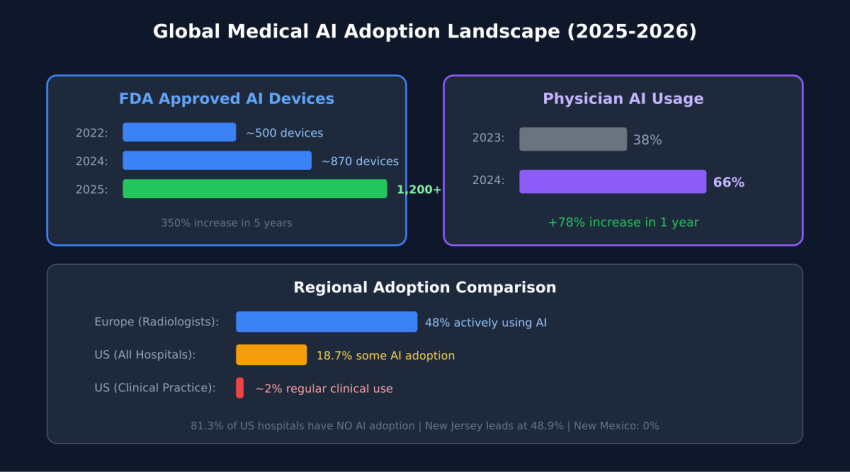
State of Medical AI Adoption: 1,200 Devices Approved, 81% of Hospitals at Zero

Posted on February 8, 2026March 4, 2026 by Admin
DOI: 10.5281/zenodo.18752906  81stabilfr·wdophcgmx
BadgeMetricValueStatusDescription
[s]Reviewed Sources0%○≥80% from editorially reviewed sources
[t]Trusted100%✓≥80% from verified, high-quality sources
[a]DOI100%✓≥80% have a Digital Object Identifier
[b]CrossRef0%○≥80% indexed in CrossRef
[i]Indexed100%✓≥80% have metadata indexed
[l]Academic100%✓≥80% from journals/conferences/preprints
[f]Free Access100%✓≥80% are freely accessible
[r]References1 refs○Minimum 10 references required
[w]Words [REQ]2,704✓Minimum 2,000 words for a full research article. Current: 2,704
[d]DOI [REQ]✓✓Zenodo DOI registered for persistent citation. DOI: 10.5281/zenodo.18752906
[o]ORCID [REQ]✓✓Author ORCID verified for academic identity
[p]Peer Reviewed [REQ]—✗Peer reviewed by an assigned reviewer
[h]Freshness [REQ]100%✓≥60% of references from 2025–2026. Current: 100%
[c]Data Charts0○Original data charts from reproducible analysis (min 2). Current: 0
[g]Code—○Source code available on GitHub
[m]Diagrams3✓Mermaid architecture/flow diagrams. Current: 3
[x]Cited by0○Referenced by 0 other hub article(s)
Score = Ref Trust (91 × 60%) + Required (4/5 × 30%) + Optional (1/4 × 10%)

Global medical AI has exploded with 1,200+ FDA-approved devices, yet 81% of US hospitals have no AI adoption. Article #2 maps the adoption paradox, regional variation, success rates by use case, and the critical barriers—with lessons for Ukrainian healthcare.

Show moreHide
DOI: 10.5281/zenodo.18752906 81stabilfr·wdophcgmx
BadgeMetricValueStatusDescription
[s]Reviewed Sources0%○≥80% from editorially reviewed sources
[t]Trusted100%✓≥80% from verified, high-quality sources
[a]DOI100%✓≥80% have a Digital Object Identifier
[b]CrossRef0%○≥80% indexed in CrossRef
[i]Indexed100%✓≥80% have metadata indexed
[l]Academic100%✓≥80% from journals/conferences/preprints
[f]Free Access100%✓≥80% are freely accessible
[r]References1 refs○Minimum 10 references required
[w]Words [REQ]2,704✓Minimum 2,000 words for a full research article. Current: 2,704
[d]DOI [REQ]✓✓Zenodo DOI registered for persistent citation. DOI: 10.5281/zenodo.18752906
[o]ORCID [REQ]✓✓Author ORCID verified for academic identity
[p]Peer Reviewed [REQ]—✗Peer reviewed by an assigned reviewer
[h]Freshness [REQ]100%✓≥60% of references from 2025–2026. Current: 100%
[c]Data Charts0○Original data charts from reproducible analysis (min 2). Current: 0
[g]Code—○Source code available on GitHub
[m]Diagrams3✓Mermaid architecture/flow diagrams. Current: 3
[x]Cited by0○Referenced by 0 other hub article(s)
Score = Ref Trust (91 × 60%) + Required (4/5 × 30%) + Optional (1/4 × 10%)
Read More
Read more

🚀 StabilarityHub Leads International MedAI Hackathon 2025: Transforming Healthcare with AI

Posted on February 3, 2026February 28, 2026 by Admin
DOI: 10.5281/zenodo.18752914  23stabilfr·wdophcgmx
BadgeMetricValueStatusDescription
[s]Reviewed Sources0%○≥80% from editorially reviewed sources
[t]Trusted17%○≥80% from verified, high-quality sources
[a]DOI17%○≥80% have a Digital Object Identifier
[b]CrossRef0%○≥80% indexed in CrossRef
[i]Indexed17%○≥80% have metadata indexed
[l]Academic17%○≥80% from journals/conferences/preprints
[f]Free Access17%○≥80% are freely accessible
[r]References6 refs○Minimum 10 references required
[w]Words [REQ]891✗Minimum 2,000 words for a full research article. Current: 891
[d]DOI [REQ]✓✓Zenodo DOI registered for persistent citation. DOI: 10.5281/zenodo.18752914
[o]ORCID [REQ]✓✓Author ORCID verified for academic identity
[p]Peer Reviewed [REQ]—✗Peer reviewed by an assigned reviewer
[h]Freshness [REQ]22%✗≥60% of references from 2025–2026. Current: 22%
[c]Data Charts0○Original data charts from reproducible analysis (min 2). Current: 0
[g]Code—○Source code available on GitHub
[m]Diagrams0○Mermaid architecture/flow diagrams. Current: 0
[x]Cited by0○Referenced by 0 other hub article(s)
Score = Ref Trust (18 × 60%) + Required (2/5 × 30%) + Optional (0/4 × 10%)

Celebrating the International MedAI Hackathon 2025 — where 50+ innovators from Ukraine, Germany and beyond collaborated to build transformative AI solutions in radiology, mental health, and healthcare operations. Led by StabilarityHub with ONPU, GROMUS, Innova Clinics, and ScanLab. Discover the winning projects and the future of healthcare technology.

Show moreHide
DOI: 10.5281/zenodo.18752914 23stabilfr·wdophcgmx
BadgeMetricValueStatusDescription
[s]Reviewed Sources0%○≥80% from editorially reviewed sources
[t]Trusted17%○≥80% from verified, high-quality sources
[a]DOI17%○≥80% have a Digital Object Identifier
[b]CrossRef0%○≥80% indexed in CrossRef
[i]Indexed17%○≥80% have metadata indexed
[l]Academic17%○≥80% from journals/conferences/preprints
[f]Free Access17%○≥80% are freely accessible
[r]References6 refs○Minimum 10 references required
[w]Words [REQ]891✗Minimum 2,000 words for a full research article. Current: 891
[d]DOI [REQ]✓✓Zenodo DOI registered for persistent citation. DOI: 10.5281/zenodo.18752914
[o]ORCID [REQ]✓✓Author ORCID verified for academic identity
[p]Peer Reviewed [REQ]—✗Peer reviewed by an assigned reviewer
[h]Freshness [REQ]22%✗≥60% of references from 2025–2026. Current: 22%
[c]Data Charts0○Original data charts from reproducible analysis (min 2). Current: 0
[g]Code—○Source code available on GitHub
[m]Diagrams0○Mermaid architecture/flow diagrams. Current: 0
[x]Cited by0○Referenced by 0 other hub article(s)
Score = Ref Trust (18 × 60%) + Required (2/5 × 30%) + Optional (0/4 × 10%)
Read More
Read more

Posts pagination

  • 1
  • 2
  • 3
  • Next

Recent Posts

  • Fresh Repositories Watch: Cybersecurity — Threat Detection and Response Frameworks
  • Real-Time Shadow Economy Indicators — Building a Dashboard from Open Data
  • The Second-Order Gap: When Adopted AI Creates New Capability Gaps
  • Neural Network Estimation of Shadow Economy Size — Improving on MIMIC Models
  • Agent-Based Modeling of Tax Compliance — Simulating Government-Citizen Interactions

Research Index

Browse all articles — filter by score, badges, views, series →

Categories

  • ai
  • AI Economics
  • AI Memory
  • AI Observability & Monitoring
  • AI Portfolio Optimisation
  • Ancient IT History
  • Anticipatory Intelligence
  • Article Quality Science
  • Capability-Adoption Gap
  • Cost-Effective Enterprise AI
  • Future of AI
  • Geopolitical Risk Intelligence
  • hackathon
  • healthcare
  • HPF-P Framework
  • innovation
  • Intellectual Data Analysis
  • medai
  • Medical ML Diagnosis
  • Open Humanoid
  • Research
  • ScanLab
  • Shadow Economy Dynamics
  • Spec-Driven AI Development
  • Technology
  • Trusted Open Source
  • Uncategorized
  • Universal Intelligence Benchmark
  • War Prediction

About

Stabilarity Research Hub is dedicated to advancing the frontiers of AI, from Medical ML to Anticipatory Intelligence. Our mission is to build robust and efficient AI systems for a safer future.

Language

  • Medical ML Diagnosis
  • AI Economics
  • Cost-Effective AI
  • Anticipatory Intelligence
  • Data Mining
  • 🔑 API for Researchers

Connect

Facebook Group: Join

Telegram: @Y0man

Email: contact@stabilarity.com

© 2026 Stabilarity Research Hub

© 2026 Stabilarity Hub | Powered by Superbs Personal Blog theme
Stabilarity Research Hub

Open research platform for AI, machine learning, and enterprise technology. All articles are preprints with DOI registration via Zenodo.

185+
Articles
8
Series
DOI
Archived

Research Series

  • Medical ML Diagnosis
  • Anticipatory Intelligence
  • Intellectual Data Analysis
  • AI Economics
  • Cost-Effective AI
  • Spec-Driven AI

Community

  • Join Community
  • MedAI Hack
  • Zenodo Archive
  • Contact Us

Legal

  • Terms of Service
  • About Us
  • Contact
Operated by
Stabilarity OÜ
Registry: 17150040
Estonian Business Register →
© 2026 Stabilarity OÜ. Content licensed under CC BY 4.0
Terms About Contact
Language: 🇬🇧 EN 🇺🇦 UK 🇩🇪 DE 🇵🇱 PL 🇫🇷 FR
Display Settings
Theme
Light
Dark
Auto
Width
Default
Column
Wide
Text 100%

We use cookies to enhance your experience and analyze site traffic. By clicking "Accept All", you consent to our use of cookies. Read our Terms of Service for more information.