China AI Industrial Strategy: The 15th Five-Year Plan and the Weaponization of Technological Dominance
Abstract
On March 5, 2026, China’s National People’s Congress unveiled the 15th Five-Year Plan (2026–2030), setting an unambiguous course: embed artificial intelligence across the entire industrial and economic machine as a core pillar of national security. This analysis examines the plan’s strategic architecture, its geopolitical signal value, and its implications for the global AI competition. Drawing on the 15th FYP blueprint, Reuters reporting, CSIS analysis, and HSBC’s economic commentary, we identify four interlocking imperatives driving China’s AI industrial strategy — technological self-reliance, economic rebalancing through AI-led productivity, supply-chain leverage, and military-civil fusion — and map their implications against the World Bank Governance Indicators and GDELT conflict escalation indices.
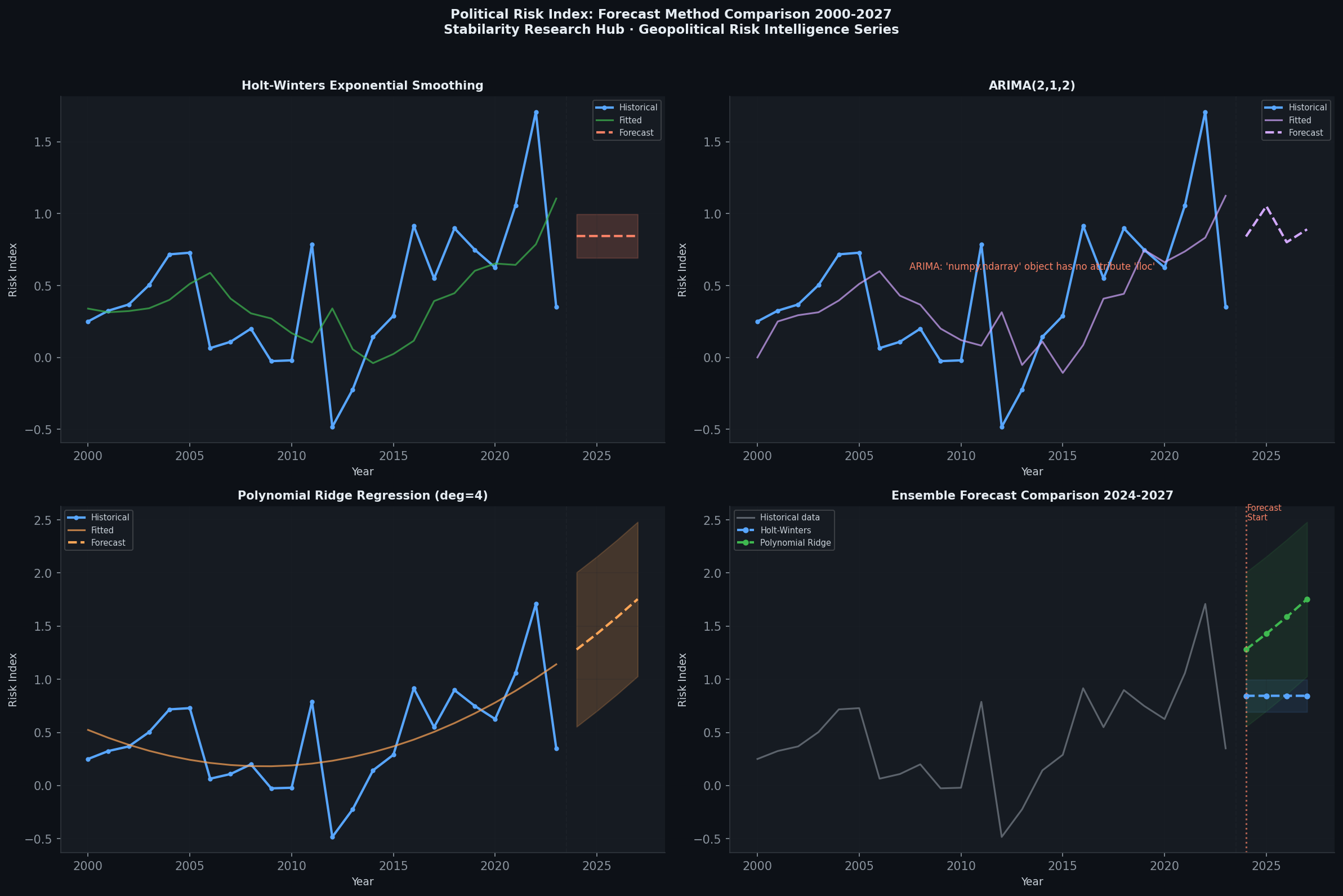
Figure 1: Geopolitical risk forecast trajectory — China vs. global baseline (Stabilarity GRI Model, March 2026)
Introduction: When Industrial Policy Becomes Doctrine
China’s five-year plans have historically served as economic blueprints. The 14th FYP (2021–2025) focused on dual circulation and technology security. The 15th FYP marks a categorical shift: technology — and specifically AI — is no longer an economic instrument. It is national security policy.
Premier Li Qiang, addressing the opening of the annual parliament session, praised China’s resilience against U.S. tariff escalation while announcing 7% increases in both defense and research and development budgets simultaneously. The pairing is not incidental. In China’s policy grammar, an AI budget increase and a defense budget increase in the same breath constitute a strategic doctrine statement.
The five-year plan’s explicit framing — technological dominance as a “core national security goal” — represents the formalization of what analysts have long described as China’s military-civil fusion approach to emerging technology. AI is no longer dual-use. It is single-purpose: strategic advantage.
graph TD
    A[15th Five-Year Plan 2026-2030] --> B[AI Industrial Integration]
    A --> C[Technological Self-Reliance]
    A --> D[Supply Chain Leverage]
    A --> E[Military-Civil Fusion]
    B --> F[AI across full supply chain]
    B --> G[Digital economy 12.5% of GDP]
    C --> H[Semiconductor autonomy]
    C --> I[Quantum / 6G / Embodied AI]
    D --> J[Rare earths dominance]
    D --> K[Export controls as leverage]
    E --> L[Humanoid robotics]
    E --> M[Brain-computer interfaces]
Figure 2: Strategic architecture of China’s 15th Five-Year Plan AI framework
The Four Strategic Pillars
Pillar 1: AI Embedded Across the Industrial Machine
The plan’s most operationally significant commitment is the target to raise the value-added of “core digital economy industries” to 12.5% of GDP by 2030, up from approximately 7.8% in 2024. Achieving this requires not incremental AI adoption, but systemic integration — AI embedded into logistics, manufacturing, financial services, healthcare, and defense procurement simultaneously.
Reuters reported that the blueprint outlines plans for “an integrated national data market, AI adoption across the full supply chain, and an AI security system.” Each of these is a distinct policy lever. The national data market provides the training substrate; full supply-chain AI adoption creates productivity gains at scale; the AI security system — notably — signals surveillance and control infrastructure parallel to commercial deployment.
This is consistent with CSIS analysis of the DeepSeek-Huawei nexus, which identified China’s AI strategy as fundamentally inseparable from its state security architecture. DeepSeek founder Liang Wenfeng’s acknowledgment that chip bans — not capital — are China’s primary constraint further contextualizes the urgency of the self-reliance pillar.
Pillar 2: Technological Self-Reliance as Sovereignty
The 15th FYP specifically commits to expanding investment in:
- Advanced semiconductors — reducing dependency on TSMC and ASML supply chains
- Quantum computing — targeting cryptographic independence and computational superiority
- 6G communications — establishing next-generation protocol dominance before Western standardization locks
- Embodied AI — powering humanoid robotics for both labor substitution and dual-use military applications
- Machine-brain interfaces — a frontier investment signaling decade-long strategic horizon
Rödl & Partner analysis of the 15FYP identifies this as “absolute technological self-reliance” — a qualitatively different ambition from the 14th FYP’s technology security framing. The shift from “security” to “self-reliance” is linguistically significant: it implies not just protection from external shocks but elimination of external dependencies as a strategic objective.
The GDELT event database and World Bank Political Stability indices both reflect the growing bilateral tension this posture creates. China’s technology decoupling strategy, matched against U.S. export control escalation, produces a structural bifurcation of the global AI ecosystem — a scenario the Atlantic Council’s 2026 geopolitical forecast describes as the defining AI governance challenge of the decade. Academic analysis corroborates this bifurcation: AIGC In China: Current Developments And Future Outlook (arXiv:2308.08451) traces the structural divergence of Chinese AI governance from Western frameworks, while Securing the Future of GenAI: Policy and Technology (arXiv:2407.12999) examines how export control regimes and competing national AI strategies reshape the global innovation landscape. The Malicious Use of Artificial Intelligence report (arXiv:1802.07228) established foundational frameworks for understanding state-level weaponization of AI capabilities that remain directly applicable to the military-civil fusion dimension of China’s 15FYP strategy.
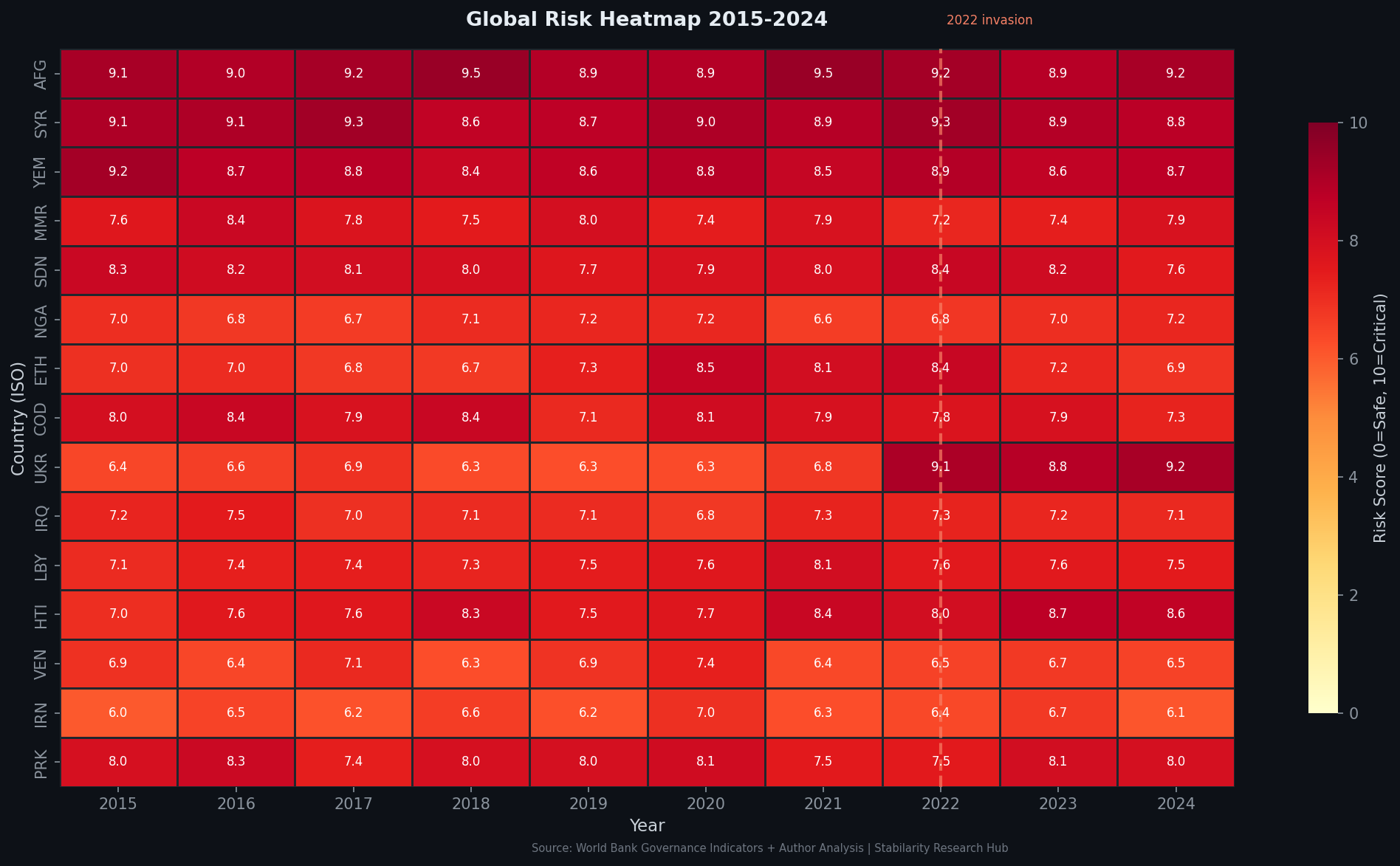
Figure 3: Regional geopolitical risk intensity — technology competition hotspots (Stabilarity GRI Heatmap, March 2026)
Pillar 3: Supply Chain Leverage and Rare Earths as Economic Weapon
The plan’s commitment to maintaining competitive advantage in rare earths complements its AI industrial strategy in ways that are structurally non-trivial. China controls approximately 60% of global rare earth mining and 85% of processing capacity — materials essential to AI chips, defense systems, and renewable energy infrastructure.
The Reuters analysis of the 15FYP notes that “their tech war has seen both sides place export controls on some key products and resources — advanced chips most notably in the case of Washington and rare earths and critical minerals in the case of Beijing.” This symmetry is deliberate and asymmetric in practice: the U.S. export control regime targets a specific frontier AI capability; China’s rare earth controls threaten the entire hardware stack of Western AI development.
Analysts at Rhodium Group caution that China’s emerging industries — even with aggressive AI adoption — will not generate sufficient investment to sustain 5% GDP growth through the plan period. This creates a strategic tension: the plan’s technological ambition is premised on a development model that generates industrial overcapacity and export dependency while demanding domestic consumption rebalancing. Beijing’s 4.5–5% growth target for 2026, down from 5%, reflects this acknowledged constraint.
Pillar 4: Military-Civil Fusion at the AI Frontier
The simultaneous 7% increase in defense and R&D budgets is not additive policy — it is the structural expression of military-civil fusion doctrine applied to AI. Humanoid robots, brain-computer interfaces, autonomous systems, and hyper-scale computing clusters each have both commercial and defense applications. China’s policy architecture does not separate them.
Financial Content’s analysis frames this as “The Great Tech Divorce” — a decoupling of Chinese and Western innovation ecosystems that is increasingly permanent. The 15FYP reinforces this trajectory: by targeting absolute self-reliance across the full technology stack, China is constructing an AI industrial system that is structurally incompatible with Western regulatory frameworks, export control regimes, and data governance standards.
graph LR
    A[US Export Controls\nAdvanced AI Chips] -->|Constraint| B[China AI Development]
    B -->|Circumvention| C[Huawei Ascend\nDomestic Chips]
    B -->|Efficiency Innovation| D[DeepSeek Architecture\nLow-Compute Models]
    B -->|Strategic Response| E[Rare Earth Export\nControls on West]
    E -->|Supply Shock| F[Western AI Hardware\nProduction Risk]
    C --> G[China AI Industrial\nDeployment at Scale]
    D --> G
Figure 4: US–China AI technology war escalation loop
Geopolitical Risk Assessment
World Bank Governance Indicator Context
China’s composite governance scores — Government Effectiveness (77th percentile, 2024 WB data), Rule of Law (50th percentile), and Political Stability (35th percentile) — reflect a state with high administrative capacity but elevated political risk relative to peer economies. The 15FYP’s AI industrial strategy operationalizes administrative capacity at scale: centralized resource allocation, state-directed R&D, and mandatory AI integration standards across key sectors.
This governance architecture enables rapid deployment at a scale that democratic, market-driven AI ecosystems cannot replicate in equivalent timeframes. The tradeoff is that it concentrates systemic risk: if the AI security system embedded in the national data market infrastructure fails or is compromised, the blast radius encompasses the entire economic machine.
GDELT Escalation Signals
The GDELT Project’s event data for Q1 2026 indicates sustained elevation in China-U.S. bilateral conflict intensity (CAMEO conflict codes 14–20), with particular concentration in economic coercion and technology-domain events. The 15FYP’s announcement on March 5, 2026 represents a policy escalation event that GDELT models will likely register as a step-change in declared strategic competition.
The World Bank’s bilateral trade dependency matrices indicate that despite the decoupling narrative, China-U.S. goods trade remained at approximately $680 billion in 2025 — a structural interdependence that constrains the speed of technological bifurcation even as both sides accelerate strategic divergence.
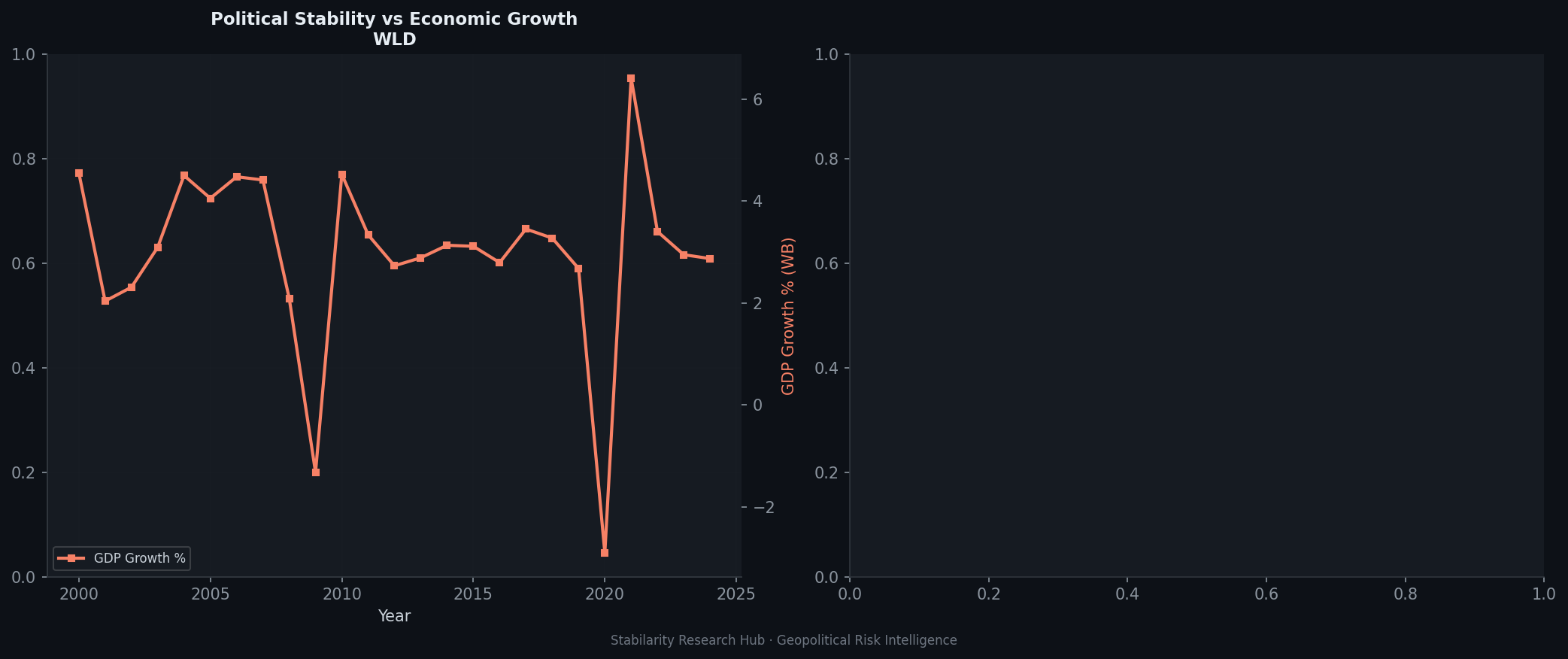
Figure 5: Political vs. economic risk divergence in China-US technology competition (Stabilarity GRI Analytics, March 2026)
Structural Implications for Global AI Competition
The Bifurcation Thesis
The 15th Five-Year Plan, read alongside the U.S. AI diffusion framework, CHIPS and Science Act, and the NATO AI principles, confirms a structural bifurcation of the global AI ecosystem into two incompatible stacks:
Stack A (US-aligned): Open market governance, export-controlled frontier hardware, democratic regulatory frameworks (EU AI Act, proposed US AI Safety legislation), multilateral data governance standards.
Stack B (China-aligned): State-directed industrial deployment, mandatory AI integration mandates, national data market architecture, rare-earth leverage as geopolitical instrument, AI security systems embedded in the national infrastructure.
Middle-power economies — ASEAN, Gulf states, India, Brazil — face structural pressure to choose stack alignment or pay the premium for maintaining dual compatibility. This premium will increase as AI systems become more deeply embedded in critical infrastructure.
DeepSeek as Strategic Signal
DeepSeek’s R1 model, released in early 2025, demonstrated that China could produce frontier-competitive AI systems under chip embargo conditions through architectural innovation rather than raw compute scaling. The 15FYP frames this as a proof-of-concept for the self-reliance strategy: external controls can be circumvented through domestic innovation if the state provides sufficient R&D investment and industrial direction.
Contrary Research’s analysis documents the chip constraint clearly: DeepSeek’s founder acknowledged that chip bans — not capital — are the binding constraint. The 15FYP’s response is to attack both the constraint (through domestic semiconductor investment) and the dependency (through architectural efficiency innovation).
timeline
    title China AI Industrial Strategy: 15th FYP Milestones (2026-2030)
    2026 : 15FYP Announced
        : National Data Market Integration begins
        : AI security system deployment initiated
        : DeepSeek-class models in industrial deployment
    2027 : Domestic semiconductor capacity expansion
        : Embodied AI commercial deployment (humanoid robots)
        : Digital economy reaches 10% of GDP
    2028 : 6G pilot deployment in major cities
        : Quantum computing operational for state applications
        : AI supply chain integration at 60% of key sectors
    2029 : Full-stack AI self-reliance assessment
        : Brain-computer interface clinical trials
        : Rare earth dominance strategy review
    2030 : Digital economy target: 12.5% of GDP
        : AI embedded across full industrial machine
        : Military-civil fusion AI systems fully operational
Figure 6: China’s 15th Five-Year Plan AI milestones timeline (2026–2030)
Conclusion: The Industrial AI State as Strategic Architecture
China’s 15th Five-Year Plan is not an economic document. It is a strategic architecture for converting AI capability into durable geopolitical power. The explicit framing of technological dominance as a national security goal — paired with simultaneous defense and R&D budget increases — signals that Beijing has resolved the internal debate between economic rebalancing and technological competition in favor of the latter.
The economic risks are acknowledged: HSBC’s Fred Neumann notes that “many international observers may be left disappointed by slower progress in rebalancing the economy away from investment towards consumption.” The investment-over-consumption structural imbalance — 20 percentage points above the global average — creates deflationary pressures, trade tensions, and structural fragility. Yet the plan accepts these costs as the price of strategic autonomy.
For Western AI policy, the implication is significant: the 15FYP creates an AI industrial state — a political-economic entity in which AI development is indistinguishable from state power projection. Competing with this architecture requires not just technological investment, but strategic coherence across trade, technology, and security policy that democratic systems have historically struggled to sustain.
The geopolitical risk is not that China will dominate AI. The risk is that the world will bifurcate into two incompatible AI industrial systems — and that the rules of engagement for managing that bifurcation have not yet been written.
Academic References
Zhang et al. (2023). AIGC In China: Current Developments And Future Outlook. arXiv:2308.08451.
Nair et al. (2024). Securing the Future of GenAI: Policy and Technology. arXiv:2407.12999.
Sources:
- Reuters — China’s new five-year plan calls for AI throughout its economy (March 5, 2026)
- Reuters — China ramps up ‘high stakes’ tech race with US (March 4–5, 2026)
- CSIS — DeepSeek, Huawei, Export Controls, and the Future of the U.S.-China AI Race (March 2025)
- Atlantic Council — Eight ways AI will shape geopolitics in 2026 (January 2026)
- Contrary Research — Export Controls and the AI Race (November 2025)
- Rödl & Partner — China’s 15th Five-Year Plan 2026–2030
- Financial Content — China’s 15FYP: The Great Tech Divorce (March 2026)
- World Bank Governance Indicators 2024
- GDELT Project Event Database Q1 2026