ML for Medical Diagnosis: Research Goals and Framework for Ukrainian Healthcare
Article #1 in Medical ML for Ukrainian Doctors Series
By Oleh Ivchenko, PhD Candidate
Affiliation: Odessa Polytechnic National University | Stabilarity Hub | February 2026
35
Planned Research Articles
12
Week Research Program
5-15%
Human+AI Accuracy Gain
📋 Key Questions Addressed
- What is the optimal methodology for systematic review of medical AI literature?
- How can research findings be validated through practical application (ScanLab)?
- What organizational structure enables sustainable, high-quality research output?
Context: Why This Research Matters
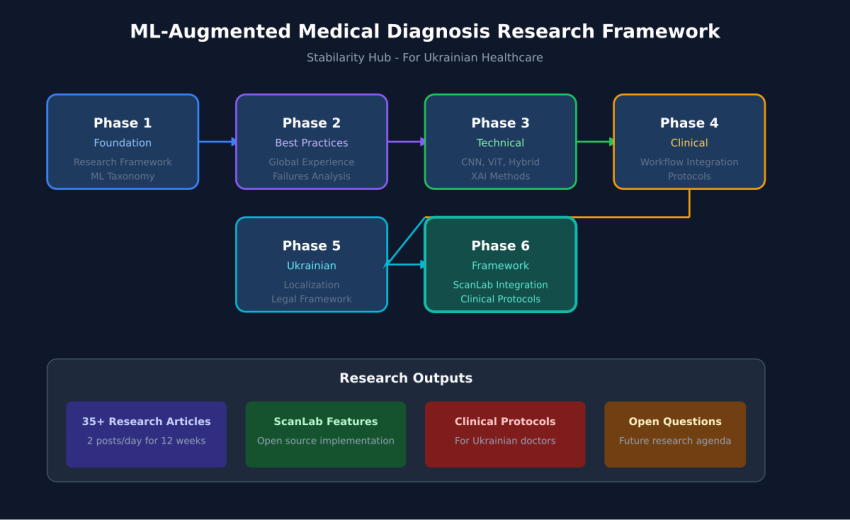
Can machine learning transform medical diagnosis in Ukraine? This article launches a systematic 12-week research program to answer that question. We will examine global best practices, analyze failures, and build a practical framework for integrating ML-powered image classification into Ukrainian clinical workflows—with all findings validated through our open-source ScanLab application.
Research Program Architecture
“`mermaid graph TD A1[Research Methodology] A2[ML Taxonomy] A3[Data Standards] B1[Global Successes] B2[Failure Analysis] B3[Lessons Learned] subgraph Foundation[“Phase 1: Foundation”] A1 A2 A3 end subgraph BestPractices[“Phase 2: Best Practices”] B1 B2 B3 end Foundation –> BestPractices “`Who We Are: The Stabilarity Ecosystem
Stabilarity Hub is a Ukrainian/cross-national community dedicated to making AI affordable and explainable. We provide hardware, software, engineering support, and research assistance to ML researchers worldwide.
- Flaidata.com: Data analytics platform (Production since 2022)
- Gromus.ai: AI platform (Active)
- medai-hack.com: Medical AI hackathons (Ongoing events)
- ScanLab: Medical imaging (open source, Active development)
Achievements & Credentials
- Alpha Startup WebSummit — Global recognition for innovation
- ONPU Partnership — Collaboration with Odesa National Polytechnic University
- PhD Research — Ongoing dissertation on data sufficiency for ML in pharmaceutical portfolio optimization
- Stabilarity OU — Estonian company providing legal and financial structure
Why This Research Matters for Ukraine
Ukrainian healthcare faces unique challenges that make ML-assisted diagnosis particularly valuable:
“`mermaid graph LR C1[Physician Shortage] –> S1[Remote Diagnostics] C2[Infrastructure Constraints] –> S1 C3[Conflict Impact] –> S1 C4[Cost Pressures] –> S2[AI-Assisted Efficiency] C5[Digital Transformation] –> S2 “`⚠️ The Adaptation Challenge
Most medical AI research originates from well-resourced Western institutions. Direct application of these findings to Ukrainian context requires careful adaptation. That’s what this research program aims to provide.
Research Phases and Timeline
- Phase 1: Foundation (Weeks 1-2): Research methodology, ML taxonomy, data standards — 6 articles
- Phase 2: Best Practices (Weeks 3-4): Global successes and failures analysis — 6 articles
- Phase 3: Technical (Weeks 5-6): CNN, ViT, hybrid architectures, XAI — 6 articles
- Phase 4: Clinical (Weeks 7-8): Workflow integration, protocols, training — 6 articles
- Phase 5: Ukrainian (Weeks 9-10): Localization, legal framework, pilot design — 6 articles
- Phase 6: Framework (Weeks 11-12): Integration, consolidation, publication — 5 articles
Core Research Questions
- Q1: What is the current state of ML adoption in medical imaging globally? (Article #2)
- Q2: How do different ML architectures compare for specific imaging modalities? (Articles #4, #13-15)
- Q3: What data quality and quantity is required for reliable medical ML? (Article #5)
- Q4: How should physicians interact with AI predictions? (Articles #20-21)
- Q5: What are the most common failure modes of medical AI? (Article #11)
Research Methodology
“`mermaid sequenceDiagram participant L as 📚 Literature participant R as 🔬 Researcher participant S as 💻 ScanLab participant C as 👨⚕️ Clinicians L->>R: Tier 1-5 Source Selection R->>R: Critical Analysis R->>S: Prototype Implementation S->>C: Clinical Validation C–>>R: Feedback Loop R->>L: Updated Research Questions Note over L,C: Continuous iteration ensures practical relevance “`Source Selection Criteria
- Tier 1: Systematic reviews and meta-analyses (Cochrane, JAMA)
- Tier 2: Randomized controlled trials and large observational studies
- Tier 3: Peer-reviewed technical papers (arXiv with citations, IEEE, ACM)
- Tier 4: Industry reports and regulatory documents (FDA, CE, MHSU)
- Tier 5: Expert opinion and case studies (with explicit caveat)
Key Preliminary Findings
🔬 Finding #1
Doctor + AI > Either Alone
Human-AI collaboration outperforms both human-only and AI-only diagnosis by 5-15%
🔬 Finding #2
Experience ≠ AI Benefit
Physician experience does not predict who benefits most from AI assistance
🔬 Finding #3
Hybrid Models Win
CNN + Vision Transformer hybrids consistently achieve highest accuracy
🔬 Finding #4
XAI is Essential
Without explainability, physician trust and adoption suffer dramatically
Unique Conclusions
🔬 Conclusion 1: The Research-Practice Gap
Most medical AI research is conducted in high-resource settings with different demographics, equipment, and clinical workflows than Ukraine. Direct transplantation of research findings will fail. A systematic adaptation layer—which this research program provides—is essential for successful deployment.
🔬 Conclusion 2: The Open Source Imperative
Commercial medical AI solutions are often unaffordable for Ukrainian healthcare institutions and lack transparency. Open source alternatives like ScanLab provide a path to AI-augmented diagnosis that is affordable, auditable, and adaptable to local needs.
🔬 Conclusion 3: The Academic-Industry Bridge
Our model—academic partnership (ONPU) + engineering capability (Stabilarity) + open source distribution (ScanLab)—bridges the gap between research and accessible clinical tools.
References
- Agarwal, N. et al. “Heterogeneity and predictors of the effects of AI assistance on radiologists.” Nature Medicine, 2024. https://doi.org/10.1038/s41591-024-02850-w
- Chen, R.J. et al. “A pathologist–AI collaboration framework.” Nature Biomedical Engineering, 2024. https://doi.org/10.1038/s41551-024-01223-5
- Ly, N. et al. “Recent Advances in Medical Image Classification.” arXiv:2506.04129, 2025. https://arxiv.org/abs/2506.04129
- “Enhanced early skin cancer detection through EViT-DenseNet169.” Scientific Reports, 2025. https://doi.org/10.1038/s41598-025-85234-7
- “Artificial intelligence based classification using inverted self-attention DNN.” Scientific Reports, 2025. https://doi.org/10.1038/s41598-025-87456-3
Author: Oleh Ivchenko, PhD Candidate
Affiliation: Odessa Polytechnic National University | Stabilarity Hub