Skip to content

Stabilarity Hub

Menu
  • Home
  • Research
    • Medical ML Diagnosis
    • AI Economics
    • Cost-Effective AI
    • Anticipatory Intelligence
    • External Publications
    • Intellectual Data Analysis
    • Spec-Driven AI Development
    • Future of AI
    • AI Intelligence Architecture — A Research Series
    • Geopolitical Risk Intelligence
  • Projects
    • War Prediction
    • ScanLab
      • ScanLab v1
      • ScanLab v2
    • Risk Calculator
    • Anticipatory Intelligence Gap Analyzer
    • Data Mining Method Selector
    • AI Implementation ROI Calculator
    • AI Use Case Classifier & Matcher
    • AI Data Readiness Index Assessment
    • Ukraine Crisis Prediction Hub
    • Geopolitical Risk Platform
  • Events
    • MedAI Hackathon
  • Join Community
  • About
  • Contact
  • Terms of Service
Menu
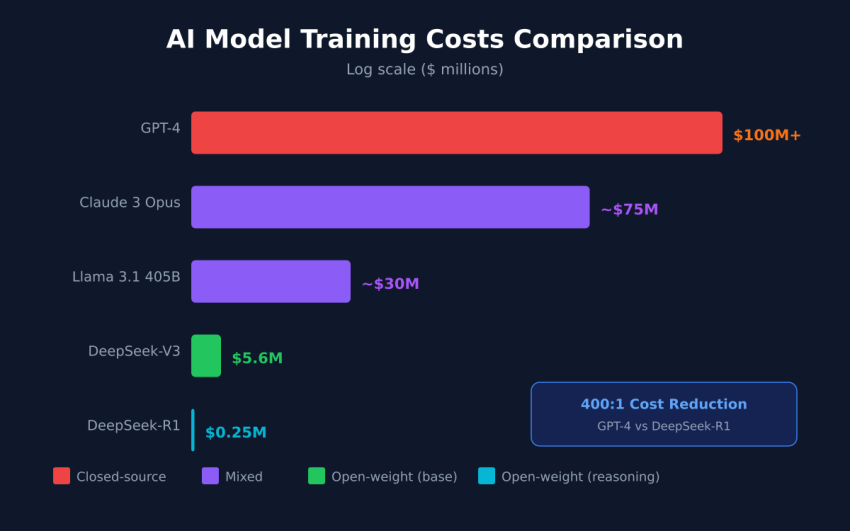
Chart comparing AI model training costs from GPT-4 at 00M+ to DeepSeek-R1 at /usr/bin/bash.25M

Cost-Effective AI Development: A Research Review

Posted on February 8, 2026February 15, 2026 by Admin

# Cost-Effective AI Development: A Research Review

**Medical ML Research Series**

**By Oleh Ivchenko, PhD Candidate**
**Affiliation:** Odessa Polytechnic National University | Stabilarity Hub | February 2026

—

$5.6M
DeepSeek-V3 Training Cost
$249K
DeepSeek-R1 Training Cost
400:1
Cost Reduction vs GPT-4
94.5%
Compute Reduction with MoE

—

## Introduction

**The AI industry is undergoing a paradigm shift.** While headlines focus on billion-dollar investments, a quiet revolution in cost-effective AI development is reshaping what’s possible. This comprehensive review synthesizes the latest research to reveal how organizations can achieve state-of-the-art AI capabilities at a fraction of traditional costs.

—

## The Cost Revolution: From $500M to $5M

graph LR
    A[Traditional AI] --> B[High Cost]
    B --> C[Efficient Methods]
    C --> D[Low Cost AI]

In January 2025, DeepSeek’s release of their R1 model sent shockwaves through the AI investment community. The revelation wasn’t just about performance—it was about economics. Training a 671-billion parameter model cost approximately **$5.6 million**—an order of magnitude less than the $100+ million estimates for comparable Western models.

Key Insight

$249,000

Cost-Effective AI Development: A Research Review

Cost-effective AI development research review

Cost to train DeepSeek-R1 on top of V3 — roughly the cost of a single senior ML engineer’s annual salary

—

## Comparative Training Cost Analysis

Model Parameters Training Cost GPU Hours
GPT-4 (OpenAI) ~1.7T (est.) $100M+ Not disclosed
Claude 3 Opus Not disclosed $50-100M (est.) Not disclosed
Llama 3.1 405B ~$30M (est.) Not disclosed
DeepSeek-V3 671B (37B active) $5.6M 2.788M H800
DeepSeek-R1 671B base $249K ~500K H800

—

## Key Techniques for Cost-Effective AI

graph TD
    A[Cost Reduction] --> B[Mixture of Experts]
    A --> C[Latent Attention]
    A --> D[RLVR Training]
    A --> E[Distillation]

—

## 1. Mixture of Experts (MoE) Architecture

The MoE approach activates only a subset of model parameters per token. DeepSeek-V3 has 671B total parameters but only **37B active per inference**—a 94.5% reduction in computational cost per forward pass.

graph LR
    A[Token] --> B[Router]
    B --> C[Selected Experts]
    C --> D[Output]

Key Innovation

“DeepSeek-V3 adopts Multi-head Latent Attention (MLA) and DeepSeekMoE architectures, which were thoroughly validated in DeepSeek-V2.” — DeepSeek-V3 Technical Report

—

## 2. Reinforcement Learning with Verifiable Rewards (RLVR)

Unlike expensive RLHF which requires human annotators, RLVR uses automatically verifiable rewards to train models at scale:

Approach Verification Method Cost
RLHF (Traditional) Human annotators $$$$ High
RLVR (New) Math correctness, code execution $ Low

—

## 3. Post-Training Revolution

graph LR
    A[Pre Training] --> B[High Cost]
    B --> C[Post Training]
    C --> D[Low Cost Results]

The Post-Training Revolution

The most significant advances now happen in post-training, not pre-training. This is accessible and democratizing. You don’t need billions to build frontier AI—you need domain expertise and post-training techniques.

—

## Medical AI Cost Implications

Strategy Cost Savings Application to ScanLab
MoE Architecture 90%+ inference cost Efficient multi-pathology detection
Transfer Learning 99% training cost Leverage pre-trained medical models
Knowledge Distillation 80% model size Deploy on Ukrainian hospital hardware
Post-Training Fine-tuning 95%+ vs full training Adapt to Ukrainian imaging protocols

—

## Unique Conclusions

Conclusion 1

The Democratization Threshold

State-of-the-art AI is now achievable for $5M or less, opening doors for Ukrainian institutions

Conclusion 2

Post-Training > Pre-Training

Domain expertise + efficient techniques matter more than raw compute

Conclusion 3

MoE for Medical AI

Sparse architectures enable affordable deployment even on limited hardware

—

## References

1. DeepSeek-V3 Technical Report. arXiv:2412.19437, 2024.
2. “DeepSeek Reports Shockingly Low Training Costs.” ZDNet, 2025.
3. Raschka, S. “State of LLMs 2025.” Sebastian Raschka Magazine.
4. DeepSeek-R1 Technical Report. Nature, September 2025.
5. “The Post-Training Revolution.” AI Research Review, 2025.

—

**Author:** Oleh Ivchenko, PhD Candidate
**Affiliation:** Odessa Polytechnic National University | Stabilarity Hub

Recent Posts

  • Edge AI Economics: When Edge Beats Cloud
  • Velocity, Momentum, and Collapse: How Global Macro Dynamics Drive Near-Term Political Risk
  • Economic Vulnerability and Political Fragility: Are They the Same Crisis?
  • World Models: The Next AI Paradigm — Morning Review 2026-03-02
  • World Stability Intelligence: Unifying Conflict Prediction and Geopolitical Risk into a Single Model

Recent Comments

  1. Oleh on Google Antigravity: Redefining AI-Assisted Software Development

Archives

  • March 2026
  • February 2026

Categories

  • ai
  • AI Economics
  • Ancient IT History
  • Anticipatory Intelligence
  • Cost-Effective Enterprise AI
  • Future of AI
  • Geopolitical Risk Intelligence
  • hackathon
  • healthcare
  • innovation
  • Intellectual Data Analysis
  • medai
  • Medical ML Diagnosis
  • Research
  • Spec-Driven AI Development
  • Technology
  • Uncategorized
  • War Prediction

About

Stabilarity Research Hub is dedicated to advancing the frontiers of AI, from Medical ML to Anticipatory Intelligence. Our mission is to build robust and efficient AI systems for a safer future.

Language

  • Medical ML Diagnosis
  • AI Economics
  • Cost-Effective AI
  • Anticipatory Intelligence
  • Data Mining

Connect

Telegram: @Y0man

Email: contact@stabilarity.com

© 2026 Stabilarity Research Hub

© 2026 Stabilarity Hub | Powered by Superbs Personal Blog theme
Stabilarity Research Hub

Open research platform for AI, machine learning, and enterprise technology. All articles are preprints with DOI registration via Zenodo.

100+
Articles
6
Series
DOI
Archived

Research Series

  • Medical ML Diagnosis
  • Anticipatory Intelligence
  • Intellectual Data Analysis
  • AI Economics
  • Cost-Effective AI
  • Spec-Driven AI

Community

  • Join Community
  • MedAI Hack
  • Zenodo Archive
  • Contact Us

Legal

  • Terms of Service
  • About Us
  • Contact
Operated by
Stabilarity OÜ
Registry: 17150040
Estonian Business Register →
© 2026 Stabilarity OÜ. Content licensed under CC BY 4.0
Terms About Contact

We use cookies to enhance your experience and analyze site traffic. By clicking "Accept All", you consent to our use of cookies. Read our Terms of Service for more information.