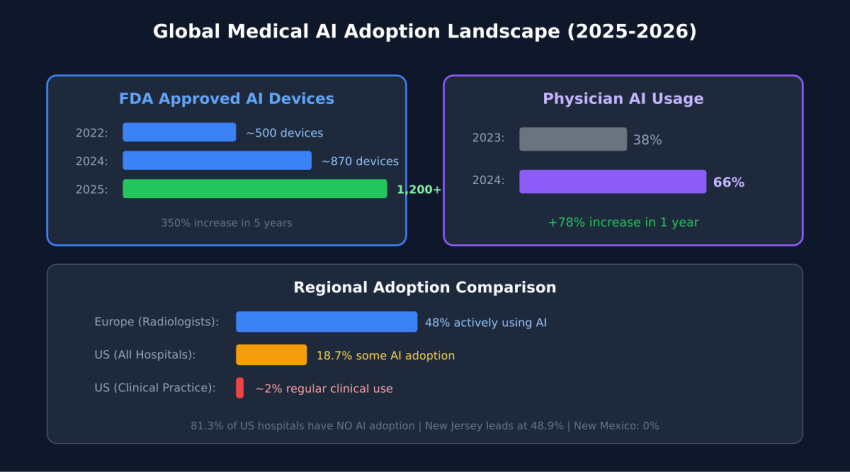
# State of Medical AI Adoption: 1,200 Devices Approved, 81% of Hospitals at Zero
**Article #2 in Medical ML for Ukrainian Doctors Series**
**By Oleh Ivchenko, PhD Candidate**
**Affiliation:** Odessa Polytechnic National University | Stabilarity Hub | February 2026
—
—
📋 Key Questions Addressed
- What is the current state of ML adoption in medical imaging globally?
- Which countries and specialties lead in medical AI deployment?
- What are the primary barriers preventing widespread clinical adoption?
—
## The Paradox Explained
**Over 1,200 AI-powered medical devices have received FDA approval, yet 81% of US hospitals have zero AI adoption.** This paradox defines the current state of medical AI: impressive technology exists, but clinical deployment lags far behind. This article maps the global adoption landscape with hard data, identifying what works, what doesn’t, and what Ukrainian healthcare can learn from international experience.
—
## FDA Approval Timeline
“`mermaid
graph LR
A1[6 Devices]
A2[~200 Devices]
A3[~500 Devices]
A4[1,200+ Devices]
A1 –>|+3,200%| A2 –>|+150%| A3 –>|+140%| A4
“`
—
## The Adoption Gap
“`mermaid
pie title US Hospital AI Adoption Levels
“No AI adoption (81.3%)” : 81.3
“Low: 1-2 use cases (8.7%)” : 8.7
“Moderate: 3-4 use cases (6.2%)” : 6.2
“High: 5+ use cases (3.8%)” : 3.8
“`
—
## Top AI Device Vendors
—
## Global Market Comparison
“`mermaid
graph TD
USA[“🇺🇸 USA
CHN[“🇨🇳 China
UK[“🇬🇧 UK
CAN[“🇨🇦 Canada
JPN[“🇯🇵 Japan
IND[“🇮🇳 India
“`
—
## Barrier Analysis
“`mermaid
graph LR
B1[” Immature Tools
B2[” High Costs
B3[” Regulatory Uncertainty
B4[“️ Clinician Distrust
B5[” Integration Issues
“`
77% cite immature tools as the primary barrier—not cost, not regulation. This means deploying proven, stable AI systems matters more than deploying cutting-edge ones.
—
## Use Case Success Rates
💡 Documentation-First Strategy
“Ambient Notes, a generative AI tool for clinical documentation, was the only use case with 100% of respondents reporting adoption activities, and 53% reported a high degree of success.” — JAMIA Survey 2024
—
## Lessons for Ukrainian Healthcare
—
## Unique Conclusions
### 🔬 Conclusion 1: The Documentation-First Strategy
Global data reveals that **clinical documentation AI has 100% adoption attempts with 53% high success**, while diagnostic AI shows 90% adoption but limited success. For Ukrainian healthcare, this suggests starting with AI for report generation before tackling diagnostic applications.
### 🔬 Conclusion 2: The Maturity Trap
The #1 barrier (77%) is immature tools—not cost, not regulation. **Deploying proven, stable AI systems matters more than deploying cutting-edge ones.** For resource-constrained Ukrainian hospitals, well-validated 2024 models may outperform poorly-validated 2026 ones.
### 🔬 Conclusion 3: The Geographic Clustering Effect
The 50x difference between New Jersey (49%) and New Mexico (0%) adoption reveals that **AI adoption clusters geographically**. Ukraine should identify “AI champion” hospitals to create similar clustering effects.
—
## References
1. “FDA AI Approvals Surge Past 1k for Radiology.” The Imaging Wire, Dec 2025.
2. “Characterizing industry payments for FDA-approved AI devices.” Health Affairs Scholar, Dec 2025.
3. “Adoption of AI in healthcare: survey of health system priorities.” JAMIA, 2025.
4. AMA Physician AI Sentiment Report 2024. American Medical Association.
5. “European Radiologist AI Survey 2024.” Insights Imaging, 2024.
6. “AI adoption challenges from healthcare providers’ perspectives.” ScienceDirect, Oct 2025.
—
**Author:** Oleh Ivchenko, PhD Candidate
**Affiliation:** Odessa Polytechnic National University | Stabilarity Hub