Cost-Effective AI Development: A Research Review
This post represents the author’s perspective and analysis but has not yet met the scientific value threshold required for full research series inclusion (academic citations, original methodology, or empirical findings). It is preserved here for informational purposes. A DOI will be assigned upon achieving required scientific standards. Readers are encouraged to verify all claims independently.
Introduction #
**The AI industry is undergoing a paradigm shift.** While headlines focus on billion-dollar investments, a quiet revolution in cost-effective AI development is reshaping what’s possible. This comprehensive review synthesizes the latest research to reveal how organizations can achieve state-of-the-art AI capabilities at a fraction of traditional costs.The Cost Revolution: From $500M to $5M #
graph LR
    A[Traditional AI] --> B[High Cost]
    B --> C[Efficient Methods]
    C --> D[Low Cost AI]
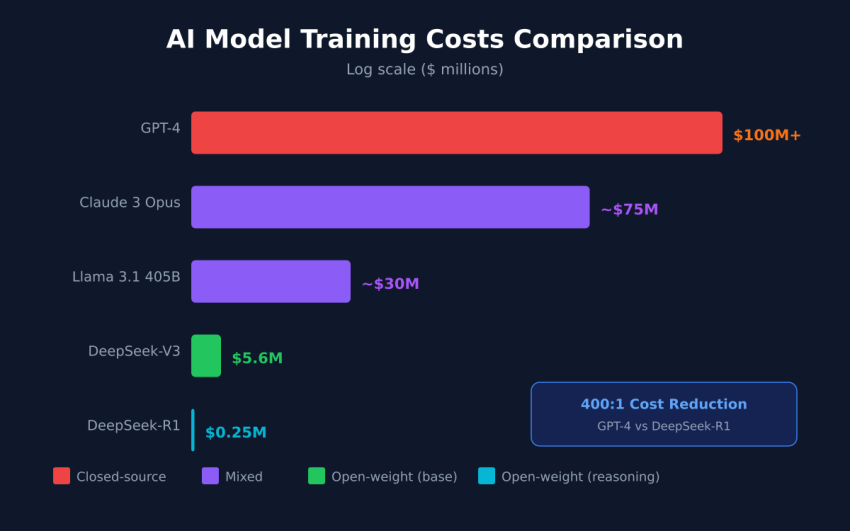
In January 2025, DeepSeek’s release of their R1 model sent shockwaves through the AI investment community. The revelation wasn’t just about performance—it was about economics. Training a 671-billion parameter model cost approximately **$5.6 million**—an order of magnitude less than the $100+ million estimates for comparable Western models.
Key Insight #
$249,000

Cost to train DeepSeek-R1 on top of V3 — roughly the cost of a single senior ML engineer’s annual salary
Comparative Training Cost Analysis #
Key Techniques for Cost-Effective AI #
graph TD
    A[Cost Reduction] --> B[Mixture of Experts]
    A --> C[Latent Attention]
    A --> D[RLVR Training]
    A --> E[Distillation]
1. Mixture of Experts (MoE) Architecture #
The MoE approach activates only a subset of model parameters per token. DeepSeek-V3 has 671B total parameters but only **37B active per inference**—a 94.5% reduction in computational cost per forward pass.graph LR
A[Token] --> B[Router]
B --> C[Selected Experts]
C --> D[Output]
“DeepSeek-V3 adopts Multi-head Latent Attention (MLA) and DeepSeekMoE architectures, which were thoroughly validated in DeepSeek-V2.” — DeepSeek-V3 Technical Report
2. Reinforcement L[REDACTED]g with Verifiable Rewards (RLVR) #
Unlike expensive RLHF which requires human annotators, RLVR uses automatically verifiable rewards to train models at scale:3. Post-Training Revolution #
graph LR
    A[Pre Training] --> B[High Cost]
    B --> C[Post Training]
    C --> D[Low Cost Results]
The Post-Training Revolution #
The most significant advances now happen in post-training, not pre-training. This is accessible and democratizing. You don’t need billions to build frontier AI—you need domain expertise and post-training techniques.
Medical AI Cost Implications #
Unique Conclusions #
Conclusion 1 #
The Democratization Threshold
State-of-the-art AI is now achievable for $5M or less, opening doors for Ukrainian institutions
Conclusion 2 #
Post-Training > Pre-Training
Domain expertise + efficient techniques matter more than raw compute
Conclusion 3 #
MoE for Medical AI
Sparse architectures enable affordable deployment even on limited hardware
References #
1. DeepSeek-V3 Technical Report. arXiv:2412.19437, 2024. 2. “DeepSeek Reports Shockingly Low Training Costs.” ZDNet, 2025. 3. Raschka, S. “State of LLMs 2025.” Sebastian Raschka Magazine. 4. DeepSeek-R1 Technical Report. Nature, September 2025. 5. “The Post-Training Revolution.” AI Research Review, 2025.**Author:** Oleh Ivchenko, PhD Candidate **Affiliation:** Odessa Polytechnic National University | Stabilarity Hub